

Transformation – what does it mean and how should it be understood in the context of industrial digitalization?
Digital transformation is a term that appears in almost every discussion about the development of companies, technology, and industry. It is mentioned in the context of strategy, investments, organizational changes, or the implementation of new IT systems. Transformation – what does it mean in practice, especially for manufacturing companies? Is it a one-time project or a long-term process? And how can real business value be found in all of this, rather than just fashionable buzzwords?
In this article, we organize key concepts, present digital transformation through practical examples, and explain how to understand it from the perspective of manufacturing plants and process automation – without unnecessary theory, but with a clear focus on tangible outcomes.
Transformation – what does it really mean?
The word “transformation” means a change in form, mode of operation, or structure. In a business context, however, it is not about cosmetic improvements, but about a well-thought-out change in how an organization operates – one that affects processes, roles, decisions, and the tools being used.
In practice, transformation:
- affects operational processes,
- requires a change in the approach to data,
- impacts team competencies,
- often involves rebuilding the IT systems architecture.
Importantly, transformation is not always a revolution on a grand scale. In industry, it is more often a sequence of logical, planned steps based on analysis and business objectives.
Digital transformation – a definition in the industrial context
Digital transformation is the process of using digital technologies to change how an organization operates, makes decisions, and achieves its business goals. In manufacturing plants, it does not come down to purchasing a new system or automating a single workstation.
In practice, it means:
- integrating data collected from machines with systems,
- shifting from reactive management to a data-driven approach,
- shortening decision-making time,
- increasing the predictability of production processes.
Digital transformation in industry covers both the operational layer (OT) and the management layer (IT), and its effects become visible only when these two worlds begin to work together.

Digital transformation vs automation – the differences
Automation is often the first step, but it is not the same as digital transformation. A production line can be automated while reporting is still done manually, data is analyzed in spreadsheets, and problems are addressed with delays.
In short:
- automation – improves individual operations,
- digital transformation – changes the way the entire process is managed.
In mature organizations, automation becomes part of a broader ecosystem – MES and ERP systems, production reporting platforms, energy management solutions, and quality management tools.
Digital transformation – production examples
Theory is one thing, but how does it look in practice? Let us look at specific examples showing how digital transformation is implemented in manufacturing plants.
1. From paper reports to real-time data
A manufacturing company replaces manual shift reports with an MES system that:
- collects data directly from machines,
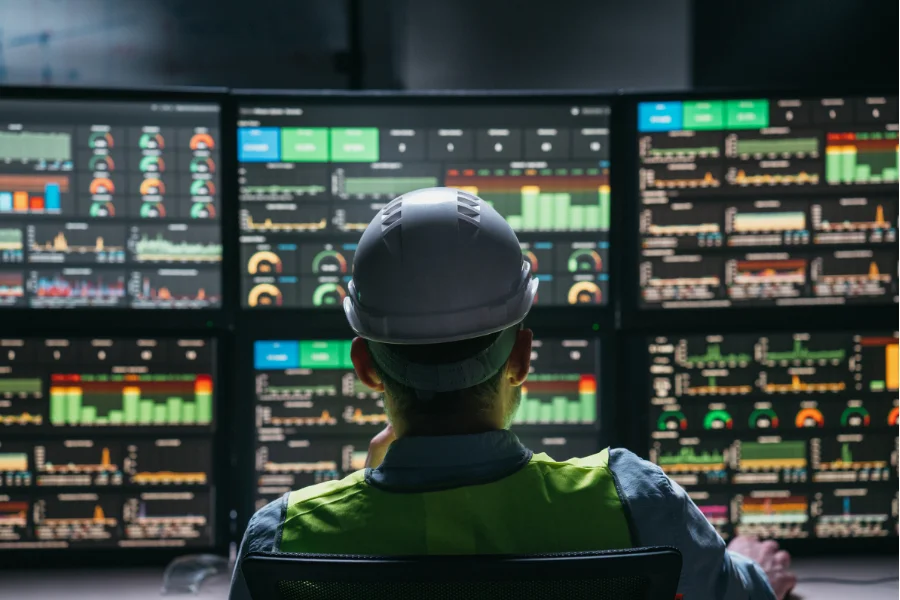
- displays the OEE indicator in real time,
- enables analysis of downtime and loss causes.
The result? Production managers respond immediately, not after the fact.
2. ERP and production integration
Digital transformation does not end on the shop floor. Integrating ERP with production allows companies to:
- plan orders more effectively,
- control production costs,
- analyze product profitability based on real data.
This is an example of a change that affects not only production, but also controlling and management.
3. Digital energy and utilities management
Implementing an EMS or CMS system makes it possible to:
- monitor energy consumption at the level of lines or machines,
- identify anomalies and losses,
- link media consumption to specific production orders.
Transformation in this area directly translates into operational costs and environmental reporting.

Are you thinking about digital transformation in your manufacturing plant but are not sure where to start?
Schedule a Free 360 Workshop and benefit from expert guidance. We will diagnose your company’s challenges and show you how to address them effectively.
4 stages of digital transformation in a manufacturing plant
From a practical perspective, transformation does not happen “all at once”. It usually consists of several stages:
- Process and data diagnosis
Without understanding what data is collected, where losses occur, and which decisions are made “by intuition”, meaningful change is difficult.
- Structuring information sources
Integrating machines, systems, and reporting tools is the foundation for further actions.
- Implementing decision-support systems
MES systems, production reporting, KPI dashboards – all to ensure that data is accessible, clear, and supports informed decisions.
- Changing the way teams work
Even the most advanced technology brings no results without changes in habits. Transformation also includes people and competencies.
The most common mistakes in understanding transformation
Many companies declare digital transformation, but in practice face problems that hinder implementation. The most common mistakes include:
- treating transformation as an IT project,
- lack of clearly defined business objectives,
- focusing on tools instead of processes,
- underestimating the role of data and system integration.
Understanding what transformation really means helps avoid these pitfalls already at the planning stage.

Digital transformation and company strategy
Digital transformation should not be an add-on to the strategy – it should result from it. In manufacturing companies, it most often supports goals such as:
- improving operational efficiency,
- reducing costs,
- increasing production predictability,
- better use of data in management.
Well-planned digital transformation does not involve implementing everything at once, but rather the consistent development of a digital environment tailored to the scale and needs of the organization.
Digital transformation is a process
Let us return to the initial question: transformation – what does it mean? In the industrial context, it can be defined as a conscious change in how a company operates, based on data, technology, and an understanding of processes.
Digital transformation:
- is not a one-time implementation,
- does not end with automation,
- requires combining technology, processes, and people.
When carried out properly, it delivers measurable results – from better production control, through lower costs, to greater organizational resilience. In this sense, it ceases to be an abstract concept and becomes a real tool for growth.
Are you planning digital transformation in your manufacturing plant? Start by organizing your processes and data. Contact the explitia team and see how to approach production digitalization step by step – without unnecessary experiments or random implementations.