



Eliminate production losses with explitia.OEE systems
Real-time production efficiency visibility
Production decisions should be based on facts, not assumptions. The explitia.OEE system gives you a clear view of performance in real time, helping you react immediately when efficiency drops.
The OEE (overall equipment effectiveness software) automatically collects data from machines and production lines, analyzes downtime, and displays production indicators in a way that operators, engineers, and managers can react to right away.
Instead of awaiting reports after the shift ends, you see what is happening currently, and what requires immediate improvement.

Turn production data into concrete operational decisions!
Get in touch with us and see how our system automatically collects machine data, analyzes downtime, and presents the OEE indicator in the context of day-to-day production management.
What you gain with OEE systems as a user?
Before going into modules and technical details, here is what companies usually expect when implementing OEE systems and what explitia delivers from day one:
 Automatic calculation of OEE (Overall Equipment Effectiveness)
 Full picture regarding availability, performance, and quality
 Clear insight into downtime causes
 Real-time monitoring of production plan execution
 Consistent efficiency indicators across lines and departments
The goal is simple: give production teams reliable data they trust, while management receives measurable indicators that support strategic decisions.

What is OEE?
OEE (Overall Equipment Effectiveness) measures how efficient machines and production lines are. It combines availability, performance, and quality into one indicator that shows you how much of your planned production time creates value.
Modern OEE software becomes a daily operational tool that links machine data to production context, allowing you to detect problems early and stabilize performance.
In production plants, OEE can be the first step toward structured, data-driven production management.
OEE in production environments
On the shop floor, OEE shows how planned machine time translates into finished products. A modern OEE system does more than present a final percentage. It can show you why the performance changes.
By collectively analyzing availability losses, performance deviations, and quality issues, the explitia solution helps you identify patterns that tend to be invisible in manual reports.
Decision-making moves closer to the production process itself. Operators know where losses start. Engineers see recurring bottlenecks. Managers gain an overview of efficiency trends.
How the explitia.OEE system works?


Automatic production data collection
Implementation starts with integration. The system connects with automation and higher-level platforms, so production data flows automatically into analysis.
Minimal requirements:
- production counter signal,
- downtime information.
It allows companies to start early and upscale the solution as needed. Most users begin with one line and scale across the plant after reviewning early results.

Real-time OEE indicators that support decisions
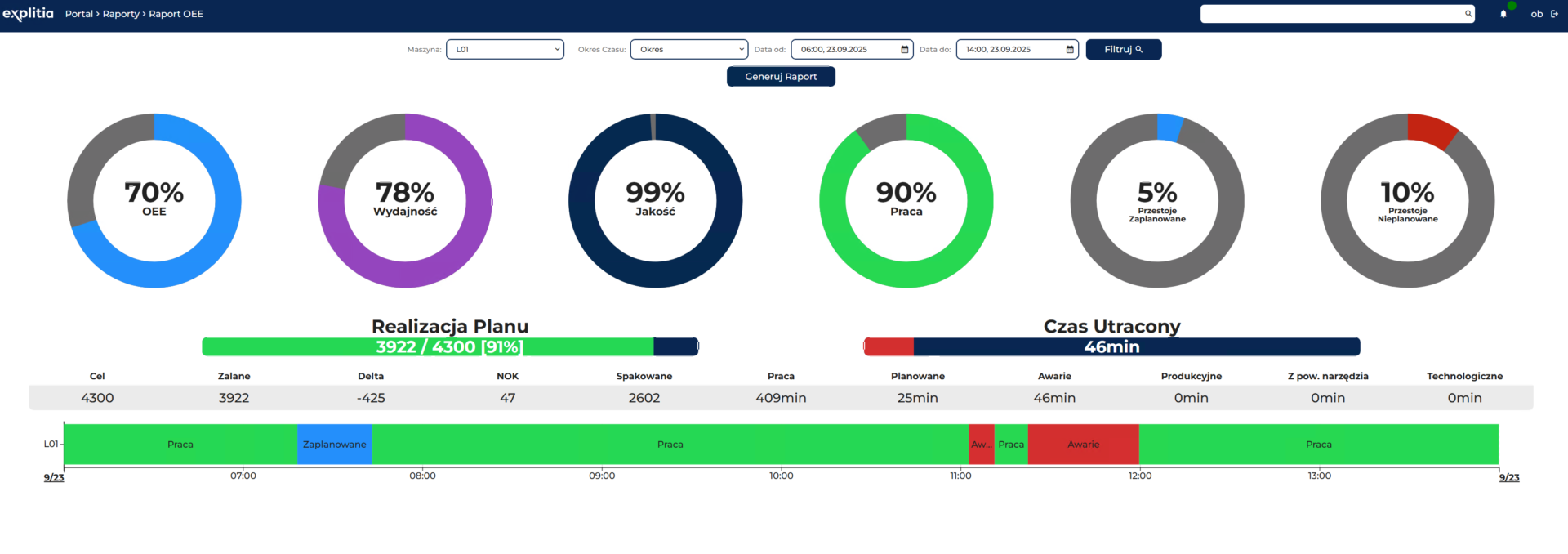
The core strength of our overall equipment effectiveness software is live visibility.
Instead of static dashboards, you see:
- current production efficiency,
- production speed compared to plan,
- quality deviations,
- performance drops.
Operators and supervisors gain precise signals about where attention is needed. Managers receive consistent indicators across departments, which simplifies communication and reporting.

Intelligent downtime analysis
Downtime is one of the biggest hidden costs in manufacturing. The explitia.OEE software focuses on understanding downtime, not just recording it.
The features include:
- automatic stop detection,
- classification of downtime reasons,
- operator input panels,
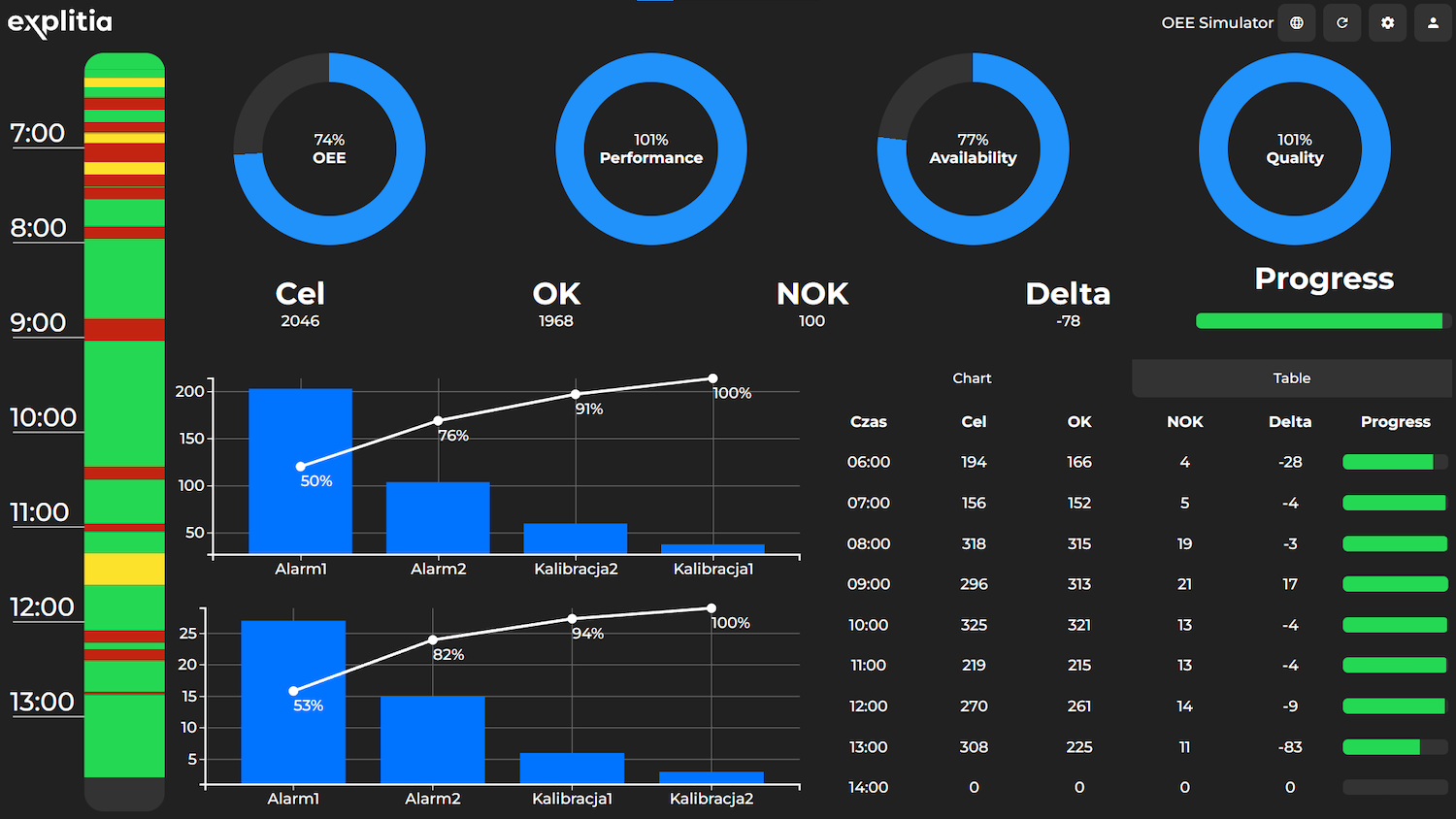
- Pareto analysis.
The module highlights which losses are the most impactful, so you can prioritize improvements based on data instead of assumptions.
Production cycle and micro-stop analysis
Short interruptions often go unnoticed but, in the aftermath, they can significantly reduce overall performance. The system analyzes micro-stoppages and cycle deviations in detail, helping you find hidden inefficiencies.
With better insight into short stops, you can improve production stability and increase OEE without additional investments.

Reporting and production analytics
Data is valuable only when it supports action. The explitia.OEE (Overall Equipment Efficiency) platform gives you production analytics designed for daily use:
- hourly performance analysis,
- production progress versus plan,
- OK/NOK quality tracking,
- filtering by shifts, operators, and lines,
- OEE analysis per product or order.
These reports help align operational teams and management around a shared source of efficiency data.
Who benefits most from the explitia.OEE?
An OEE system can work effectively in various production environments. Below are a few examples from selected industries.
Discrete manufacturing (automotive, metal, assembly)
In repetitive production environments, precise cycle analysis helps detect deviations quickly.
Clear identification of production units makes OEE systems effective for monitoring efficiency over time.
Continuous production (FMCG, chemicals, food)
Continuous processes require synchronization between stages.
The system analyzes material flow and production dependencies, helping you avoid downtime caused by process imbalances.
Packaging lines and end-of-line operations
Packaging can become a bottleneck due to material availability or quality issues.
The explitia OEE solution connects packaging performance with upstream production data, giving you a full picture of efficiency.

Discover where you are really losing efficiency!
Write to us and see how explitia.OEE helps identify downtime, micro-downtime, and quality deviations that affect your production results more than you might think.
Typical challenges solved by OEE software
Before implementing overall equipment effectiveness software, the obstacles in manufacturing typically include:
| Fragmented efficiency indicators |
| Manual reporting processes |
| Limited insight into downtime causes |
| Difficulty comparing production lines |
| Low process transparency |
The explitia platform converts machine data into operational knowledge, helping you move from reactive problem-solving to structured improvement.
explitia.OEE system within the Production Portal
The explitia.OEE system is part of a broader Production Portal ecosystem, which ties performance data to other operational areas:
EMS
The combination of OEE and EMS makes it possible to analyze energy consumption in the context of performance, making it easier to identify areas of loss and assess the efficiency of production processes.
More
CMMS
The combination of CMMS and OEE enables automatic failure reporting, allowing maintenance to respond more quickly to issues affecting machine availability.
More
MES and SCADA
The combination of OEE with MES- and SCADA-class systems makes it possible to place efficiency data in a production context, allowing for better interpretation of the causes of losses and deviations.
More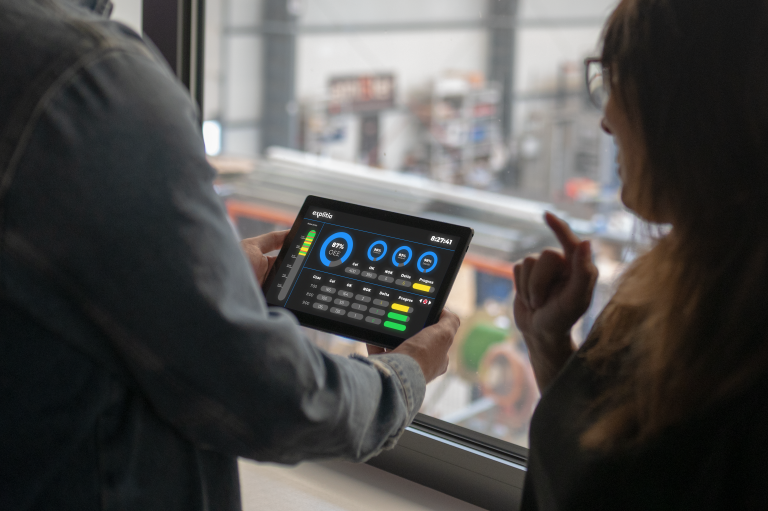
Traceability
The combination of OEE and traceability makes it possible to analyze quality and costs in relation to specific batches, series, and production events.
More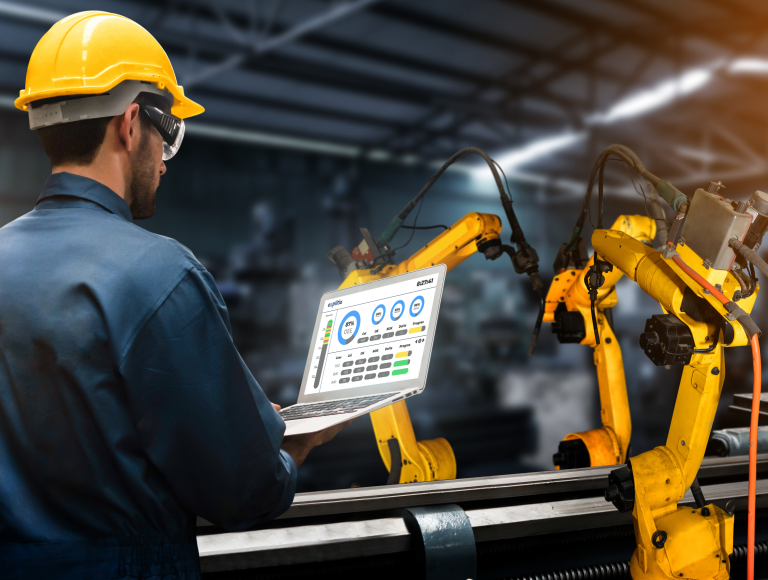
This integrated approach allows companies to analyze OEE (Overall Equipment Effectiveness) in relation to maintenance, energy, and quality indicators, and builds a stronger foundation for long-term improvement.
Business benefits of implementing OEE systems
| Higher productivity without new machines | Better visibility in performance allows you to increase output using existing resources |
| Lower production costs | Fast detection of bottlenecks helps reduce downtime and improve planning accuracy |
| More stable production flow | Real-time data allows you to react early to deviations, preventing larger disruptions |
| One consistent efficiency standard | A shared view of OEE across departments supports better collaboration and clearer reporting structures |
Implementation approach at explitia
The deployment process focuses on delivering measurable value quickly:
Discovery call
Infrastructure and process assessment
Budgetary offer
Pilot implementation on a selected production line
Automation of data collection
Scaling across additional areas
As technical requirements are minimal, you can usually see the first operational improvements shortly after launch.
Start improving production efficiency today
If you are considering OEE systems or looking for practical OEE software that supports your operational decisions, the explitia solution can offer a clear path forward.
Schedule a free consultation and see how this Overall Equipment Effectiveness software can help your team increase productivity, reduce losses, and build a data-driven production environment.