



Eliminate paper-based workflows in production with explitia.Forms module
Turn manual records into structured production data
Not every important piece of production data comes from a machine, PLC, or connected system. Some of it still comes from people. A completed task, checked parameter, quality check result, status update. Any process event that cannot be recorded automatically.
These records are important. Yet in many plants, they still live on paper, in spreadsheets, or in local files. It makes it harder to access, harder to verify, and to use later.
explitia.Forms collects manual records in one digital environment, so your plant can work with cleaner, more complete, and more useful production data.
Scattered notes become structured. Disconnected records turn into a clear flow of information.
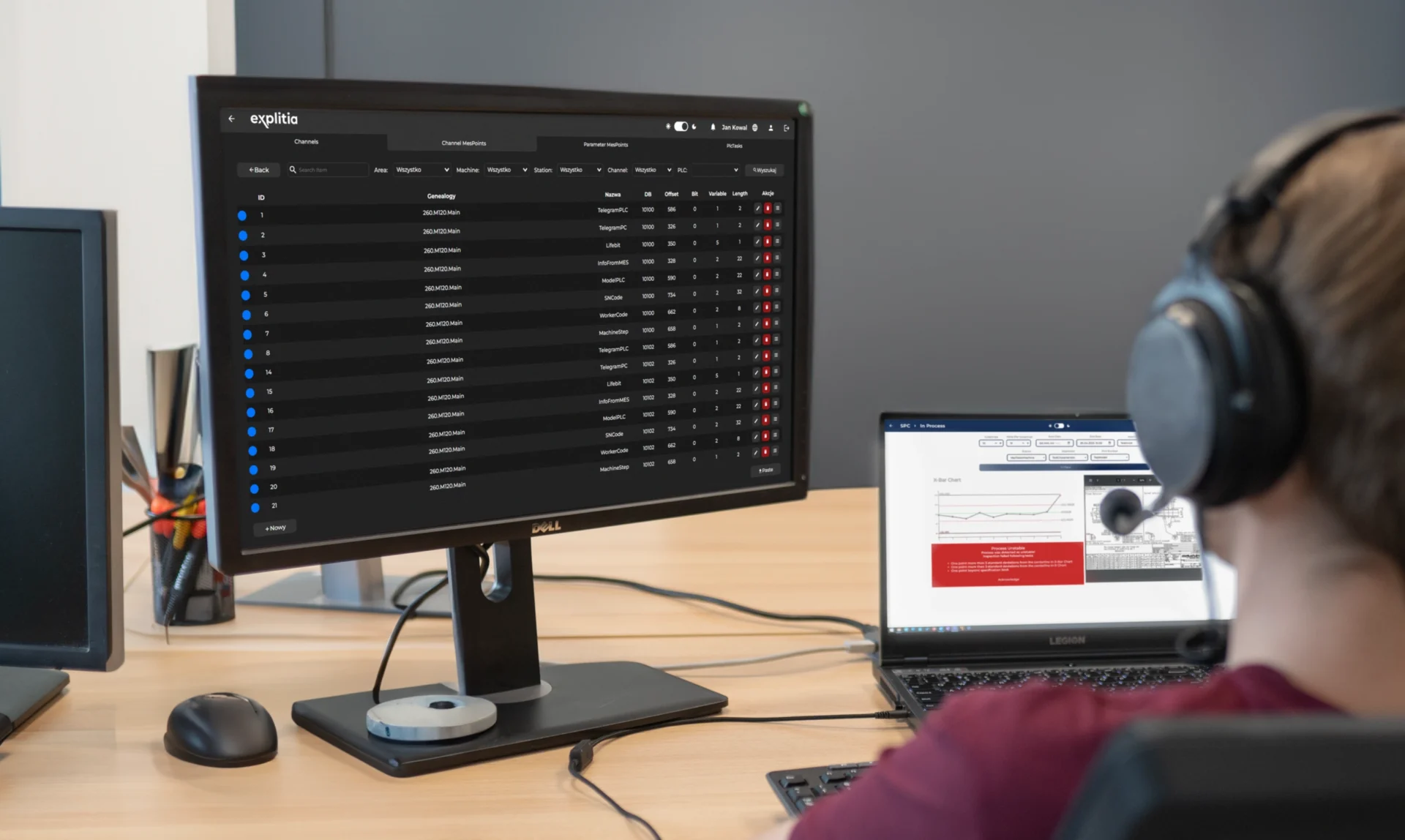
Bring manual records into one clear digital flow with explitia.Forms
See how the Forms module can help your plant replace paper and local files with structured production data. Contact us and discuss the scope for your plant.
What you gain with the Forms module?
At a practical level, the Forms module helps you organize the part of production that still relies on manual input.
With explitia.Forms, you get:
 One place for manual data entry
 Less paper and fewer local files
 More order in production and operational records
 Faster access to entries needed for reports, reviews, and visual screens
 A way to fill gaps where automation does not cover the full process
 Forms aligned with the task, the role, and the point of work
 Stronger links between manual entries and the rest of your plant data
For your team, the process remains simple. For your business, the information becomes easier to use across daily operations.
That is where digitization of data circulation brings you true value.

A fuller picture of production with Forms module
Even in plants with a high level of automation, some parts of the process still rely on human input.
- An operator confirms that a step has been completed.
- A technician enters a reading.
- A quality employee records the result.
- A warehouse worker updates the status.
- A supervisor notes an event that matters for review, continuity, or follow-up.
Without those entries, your production picture is incomplete.
explitia.Forms gives these records a place inside the system. You can enter data at the right moment, and it becomes available to the people who need it across production, quality, office work, supervision, and management.
The Forms module helps you close the gap between what equipment can register and what your people still need to record.
Simple for the user, useful for the business
A digital form needs to work in your production conditions. For the person entering data, it should be quick and clear.
| Open the form |
| See the right fields |
| Enter the information |
| Move on |
For the business, the value comes from what happens next. Records need to be structured, accessible, and ready for reports, dashboards, visual screens, and daily control. explitia.Forms supports both sides.
It keeps data entry straightforward for operators while giving the company better order in the wider flow of information. Manual records are no longer scattered between paper notes, spreadsheets, and local files. They are now part of a connected environment.
That is one of the clearest benefits of data flow digitization. Manual input no longer sits outside the system.
Where explitia.Forms works best?
The Forms module comes in handy especially wherever information must come from a person rather than from a machine.
Common areas of use include:
- production lines and machine stations
- warehouse operations
- transfer points between stages
- quality control stations
- task confirmation points
- process steps where a worker needs to enter a value, status, event, or note

explitia.Forms is not limited to one part of the plant. It supports the wider flow of work wherever manual input has operational value. If a record matters to the process, the Forms module gives it the place it deserves.

That is why Forms in production covers more than the production line itself. It is a tool for every place where manual input has operational value for the flow of work.
What kind of data you can collect?
The scope of a form depends on the process. In some cases, a single confirmation is enough. In others, the form may require several fields linked to a task, a control point, or a specific stage of work.
With explitia.Forms, you can collect:

Confirmations of completed tasks
They make it easy to record that an action has been completed at a specific stage of the process. The entry goes directly into the system instead of being lost in paper notes or local files.

Manually entered readings and process parameters
They help record values that cannot be collected automatically from a machine, controller, or another system. They complete the picture of the process with data that matters for production, quality, and analysis.

Tank, asset, or resource status
They let your team record the current status of available materials, utilities, or other resources used in the process. This supports better operational control and faster response to change.

Quality-related data
They support recording inspection results, observations, and other information important from a quality perspective. This keeps the data structured and available for reporting, review, and analysis.

Organizational information
This includes information needed for smoother work organization, task flow, and process coordination. Recording it in the system brings better order to communication between production, office teams, and management.

Process events that cannot be registered automatically
They capture situations that the system will not detect on its own but that still matter for the process. This gives the company a fuller and more reliable view of what is really happening in production.
These entries often provide the missing context around automated data.
The Forms module helps you keep that context inside the system, where it can be reviewed, compared, and used by other teams.
Better order across teams
The same record often matters to different people for different reasons.
For an operator, it needs to be quick to enter. For a supervisor, easy to review. For a technologist, visible in context. For management, reliable and easy to access.
explitia.Forms connects these needs in one environment.
It gives you clear day-to-day benefits: less time spent searching for records, fewer delays between entry and review, less rewriting of the same information, better visibility across departments, more consistent reporting, more control over the process
The value is not limited to cleaner data entry. It extends to the quality of the information flow that follows.

See how to start using explitia.Forms
Start benefiting from the module. Schedule a consultation and see where explitia.Forms will work best in your production environment. Write to us today.
Why digitization of data circulation is so important?
Most plants already collect a large amount of data automatically. Yet part of the real process still happens outside the main system.
- A value in a notebook.
- A shift note in a local file.
- A paper confirmation.
- A manually recorded event entered too late.
Each entry may seem small on its own. Together, they shape how complete and reliable your production data really is.
Digitization of data circulation helps you move those records into the same operational flow as the rest of your plant data.
With explitia.Forms, manual entries become easier to record, find, review, and use across the plant.
Forms module as part of a wider system
explitia.Forms works best when manual entries become part of the wider production environment instead of sitting next to it.
Data collected through the Forms module can be used in:
| Visual screens |
| Reports |
| Office workflows |
| Management review |
| Comparisons with automation data |
| Support processes linked to production |
Your manual records play a broader role in the business.
They are no longer separate notes stored in different places, but part of the same information flow that improves production control, analysis, and decision-making.
Here, these forms of data flow digitization move from an improvement to a business advantage.
explitia.Forms and other modules
The explitia.Forms module works very well with other modules of the Production Portal:
Production
explitia.Forms does not replace the Production module. It complements it. Automatic collection gives you one part of the production picture. Manual records add the information that still needs to be confirmed, entered, or described by a person. Together, they create a broader and more accurate operational view.
More
Traceability
The Forms module is not primarily designed for full product genealogy or item-level tracking. The roles are different. It collects manual records when automatic registration is not enough. In processes where traceability depends partly on human input, explitia.Forms helps keep records more complete and easier to review.
More
Web layer and dashboards
explitia.Forms also fits naturally with web screens, dashboards, and other system views used across the plant. Forms can include different controls and interface elements depending on the task, the process step, and the role of the user. It keeps manual data close to the environment where teams already work with information.
More
Forms built around the process
Every plant has its own way of working. Manual records appear at different points, involve different people, and serve different purposes.
For this reason, explitia.Forms is not based on one rigid form structure.
Forms can be short and direct where handling time counts. They can also be broader where you need more detail. What matters is that the user sees the right fields at the right point in the process.
It helps you facilitate:
- easier and faster data entry
- better consistency across teams
- fewer incomplete or misplaced records
- stronger usability in daily work
It makes digitization of data circulation easier to introduce because the form follows the process, not the other way around.
Business benefits of the Forms module
When manual records move into an organized environment, the impact goes beyond the point of entry.
The main business benefits of explitia.Forms include:
| Less time lost searching for records |
| Less manual rewriting of information |
| More order in production and operational data |
| Easier access for different teams |
| Lower risk of important entries staying outside the system |
| Simpler reporting and analysis |
| A more complete view of the process |
| Stronger links between manual and automated data |
It applies to production, quality, planning, supervision, reporting, and internal coordination. It also means a stronger base for everyday decisions.
How explitia.Forms supports sales and future system growth
Better internal information flow does not only improve plant operations. It also aids in customer service, delivery control, and communication between teams.
When manual records are easier to access and review, your people spend less time filling information gaps and more time working with facts. Processes become clearer. Follow-ups get easier. Internal communication improves.
explitia.Forms can also be a good starting point for wider system growth. Once manual records are brought into one environment, it becomes easier to connect them with reporting, visual screens, and broader production data.
It gives the Forms module value today and long-term relevance as your system develops.
Who explitia.Forms is for
explitia.Forms is a strong fit if your plant still relies on manual input in important parts of the process.
It is especially relevant when:
| Some production data is still recorded by hand |
| Records are spread across paper, spreadsheets, and local files |
| You want better digitization of data circulation without disrupting day-to-day work |
| Automation does not provide the full picture of the process |
| You need stronger links between manual records, reporting, and operational control |
| You want one clear place for entries that matter across the business |
If this description reflects your current situation, the Forms module can help you bring more order into the plant while keeping daily work practical for your team.
Bring manual records into the system with explitia.Forms
If important information in your plant still exists outside the main system, explitia.Forms gives you a better way to manage it.
It replaces scattered records with structured digital data, supports a clearer flow of information, and helps your teams work with a more complete operational picture.
Your people keep recording what matters, and your business now has one place to use it well.