



Identify product origin with explitia.TRC – Traceability systems
A traceability system for manufacturing
With traceability, you know what a product is made from, how it moved through production, and where to look when a problem comes up.
When a customer raises a complaint, the quality team asks for records, or an audit requires the full product history; you do not want to search through multiple systems, spreadsheets and notes. You want one place where the full picture is available right away on aspects like:
- What materials were used to make the product?
- Which production stages did it go through?
- Which machines were involved?
- Which batch is it linked to?
That is what explitia.TRC is built for.
It gives you full traceability and fast access to the data that matters when time, accuracy, and certainty matter most.

Get full production traceability in your plant!
See how explitia.TRC helps you track product history, material links, and the full production flow in one place. Contact us and discover how traceability can work in your company.
What you get as an explitia.TRC user?
A production traceability systems gives you quick and easy access to the history of the product and the process behind it. You answer questions faster, respond to issues sooner, and keep data in order across the company.
With explitia.TRC, you can:
 Check the history of a specific unit, batch, or serial number
 See which components, semi-finished goods, and material batches were used to make the product
 Recreate the production flow step by step
 Respond faster to complaints, quality issues, or a batch recall
 Reduce manual work when preparing documentation
 Keep current and historical data in one place
 Connect traceability with ERP, warehouse operations, production orders, and SPC
 Prepare more efficiently for audits and customer requirements
This matters for more than quality. It also supports sales, customer service, and day-to-day production management.

What is traceability?
Traceability means being able to identify a product and follow its path through production. It lets you reconstruct the product history from raw material to finished product.
In one place, you can see what the product was made from, how it was produced, and what links appeared at each stage of the process.
How does traceability work at explitia?
You do not get a fixed module that looks the same in every factory. You get a system built around your process.
Every production environment works differently. Routing differs. Technology dependencies differ. Marking methods differ. The level of tracking differs.
The scope of data collection differs. A good traceability system needs to reflect how production actually works in your plant.
Implementation starts with process mapping.
Together, we define:
| what needs to be tracked, |
| where identification begins, |
| which production stages matter, |
| which machines are involved, |
| which data needs to be collected, |
| which systems the data should come from. |
That is why traceability is more than a set of records. It becomes a useful tool for production, quality, and complaint handling.
Product and process genealogy whenever you need it
One of the biggest strengths of a traceability system is the ability to follow the full genealogy of the product.
You do not only see the finished item. You also see:
- what it was made from,
- which stages it went through,
- which operations were performed,
- which materials, machines, and batches were linked to it.
It is where explitia.TRC shows the value of traceability systems.
When a complaint appears, you are not left to guess. You can quickly check whether the issue affects one unit, a full batch, a specific material, or a specific part of the production flow.
When you are preparing for an audit, you do not waste time looking for data in different places. You have a clear process history and a ready record of how production unfolded.
When a faulty product needs to be recalled, you can act with precision. You reduce the scale of the issue, the cost, and the disruption around it.


Fast complaint analysis
When a complaint appears, you are not left to guess. You can quickly check whether the issue affects one unit, a full batch, a specific material, or a specific part of the production flow.
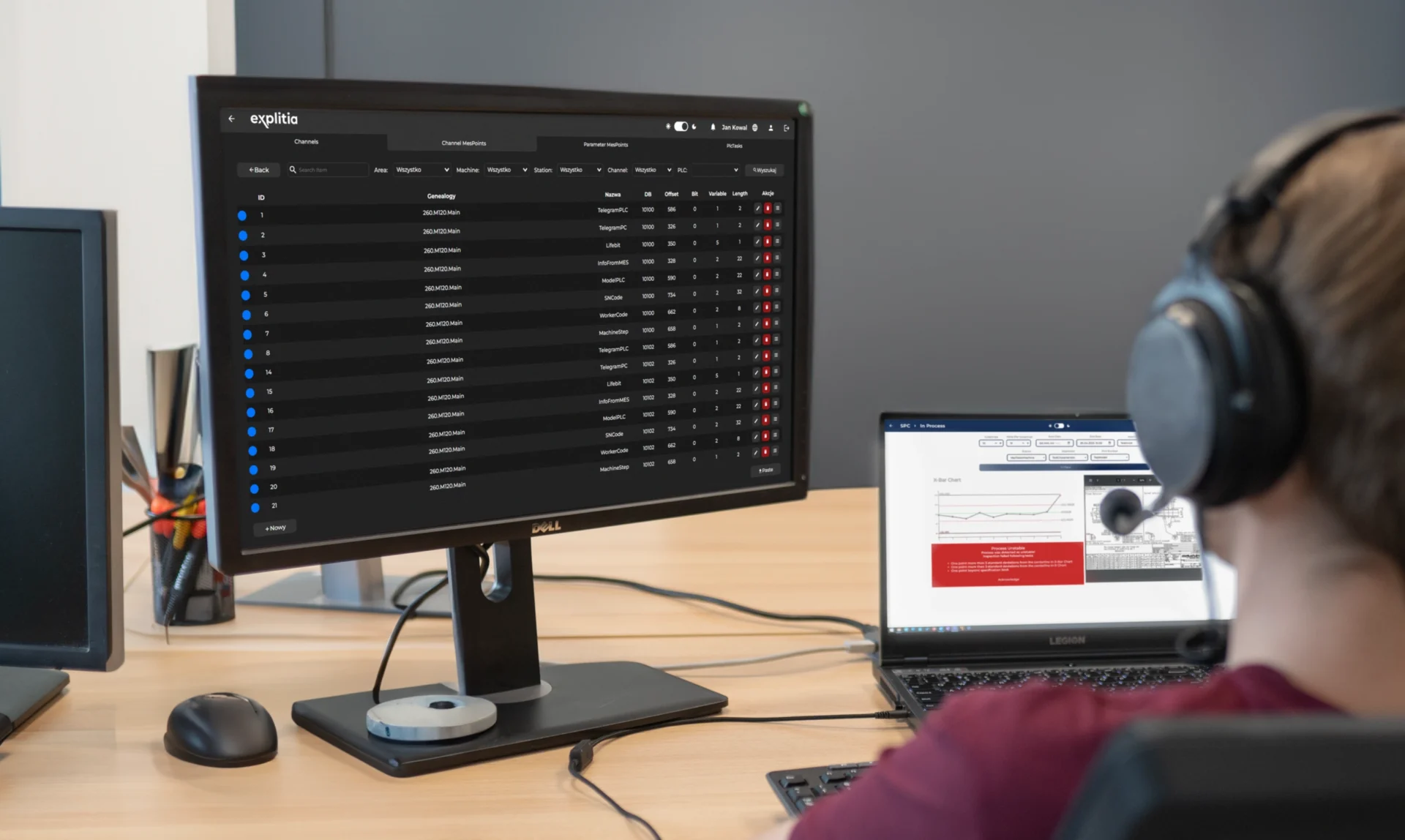
Clear process documentation
When you are preparing for an audit, you do not waste time looking for data in different places. You have a clear process history and a ready record of how production unfolded.
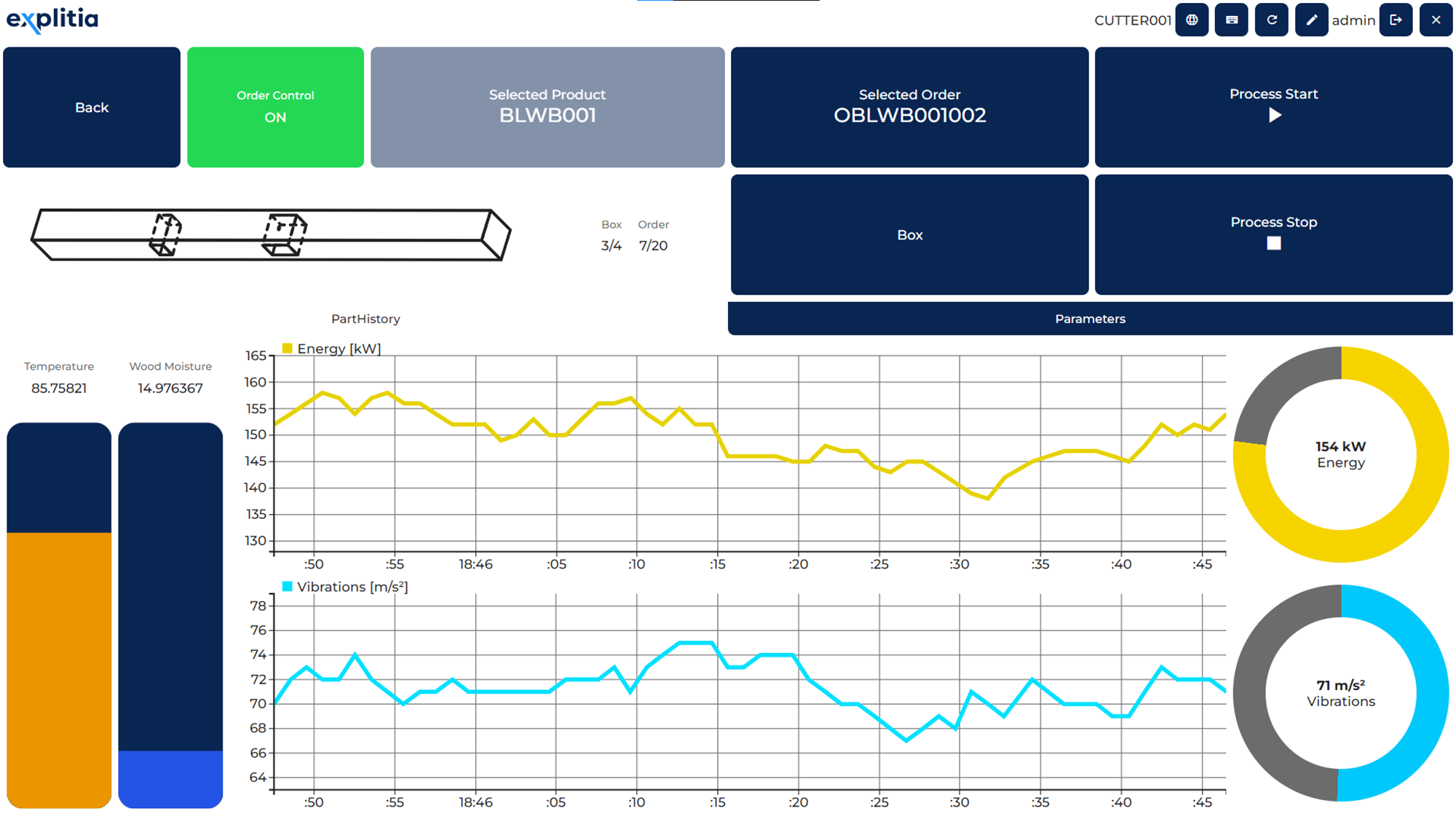
Precision in action
When a faulty product needs to be recalled, you can act with precision. You reduce the scale of the issue, the cost, and the disruption around it.
What data can traceability include?
For traceability to bring clear value to your plant, it needs to connect data that is often scattered across different sources.
Depending on the process, explitia.TRC can collect information about:
- components used in production,
- raw material and material batches,
- semi-finished goods,
- suppliers,
- production batches,
- serial numbers and individual identifiers,
- the time and place of each operation,
- machines involved in production,
- operators and workstations,
- parameters related to how the product was made,
- links between the finished product and earlier production stages.
Instead of pulling answers from several places, you get one consistent product history.

Turn scattered data into a complete product history!
explitia.TRC does more than store production data. It helps you respond faster to issues, prepare for audits, and build full product traceability. Write to us and see how it can work in your plant.
When does traceability make the most sense?
The most obvious example is automotive, where unit marking and clear identification are often required. But a production traceability system is not limited to one industry.
It works wherever you need to track the flow of materials and products, keep the process clear, and have the production history close at hand.
If you already use product marking and want to move to full unit or batch tracking, traceability is usually a better choice than interim tools that stop being enough as your needs grow.
What you need to define before implementation?
Good traceability starts with understanding the process. Without that, the system will not show the real picture of production.
Before implementation, you need to define:
| How your production runs from start to finish, |
| Which stages, machines, and dependencies are involved, |
| Where identification takes place, |
| Which data needs to be collected, |
| How units, batches, or components are marked, |
| Which systems the information needs to come from, |
| What the implementation is expected to achieve. |
On the plant side, you also need the right technical base: a server, internal network, and a prepared automation environment. It also matters that the people who know the process are available to describe it clearly.
How traceability connects with other areas of your production plant?
Traceability brings the most value when it is connected with the rest of the production environment.
Among others, it connects with:
ERP
Traceability uses ERP data to link the product with the order, materials, supplier, and execution flow.
More
WMS and warehouse operations
Thanks to integration with warehouse operations, you can determine exactly where the raw material came from and where the finished batch was sent.
More

Production orders
Traceability links the product with a specific production order, which makes it possible to reconstruct the full context of how it was made.
More

SPC
Combined with statistical process control data, it lets you check whether parameter deviations had an impact on batch quality.
More

Production reporting
Reporting data shows when, where, and under which conditions a given product or series was made.
More

Quality control
Quality results are assigned to a batch or unit, which makes it easier to assess compliance and respond quickly to non-conformities.
More

Machine data
Information from production equipment helps trace the operating parameters that accompanied the manufacture of the product.
More

Product and batch marking
Proper marking provides the reference point that links the physical product with its digital history.
More

It matters because it shows you that traceability is not a separate add-on. It is part of a broader production management environment, such as the explitia Production Portal.
explitia.TRC also supports sales
A traceability system supports more than production and quality. It also supports sales.
When you are speaking with a demanding customer, the ability to show the full product history strengthens your position at the offer stage. You show that you control the process, respond quickly to questions, and are prepared for quality requirements.
It is important when the customer expects:
- confirmation of material origin,
- production history,
- compliance with industry requirements,
- a fast response to a complaint,
- the ability to narrow the issue down to a specific batch or unit.
Business benefits
explitia.TRC can bring measurable business benefits
| Shorter response times |
| Lower cost of manual data searches |
| Reduced losses when a faulty product has to be recalled |
| Easier compliance with customer expectations and external standards |
| Better cooperation between departments |
| Working with the same data |
That is why product traceability is not only a quality topic, but also an operational, financial, and commercial one.
How is explitia.TRC implemented?
We learn how your process works and which business goals matter most
We define the scope of traceability and the main tracking points
We design the system around the reality of your production
We connect traceability with your systems, data, and plant infrastructure
We launch the system and support your team as they start working with the new data
Why choose explitia.TRC?
You are choosing more than a module. You are choosing an approach that combines proven mechanisms with a system built around your process.
With explitia.TRC, you get:
| A shorter path to implementation, |
| A system that reflects how production really works, |
| Fast access to the right data, |
| Stable performance in a manufacturing environment, |
| Room to grow together with other parts of the platform. |
In the end, the goal is simple: the system should work well, show the right data, and help your team when they need it most.
Want to see how traceability could work in your company?
Show us your process, and we will show you how to build a traceability system that gives you full control over material flow, product history, and process compliance.