

Energy consumption monitoring in an EMS system – how it works and what savings it delivers?
Table of contents
- What Is an EMS and How Does It Work?
- Who Are EMS Systems Designed For?
- Differences Between EMS and HEMS
- Core Functions of an Energy Management System
- Benefits of Implementing an EMS
- Key Components of an EMS
- Integrating EMS with Other Technologies
- Using Dynamic Energy Tariffs
- Practical Aspects of EMS Implementation
- 21st-Century Energy Monitoring
Energy consumption monitoring offered by Energy Management System (EMS) has become an essential element of modern energy management. Why? Well, we probably don’t need to convince you that in the face of rising electricity prices and increasing pressure on energy efficiency, failing to invest in energy monitoring is a sign of ignorance.
EMS systems play a significant role in reducing energy consumption. Moreover, they support pro-environmental objectives and help companies meet strict environmental standards.
If you’re still wondering whether an EMS is right for you and how it can reduce costs in your production facility, make sure to read this article.

What Is an EMS and How Does It Work?
Since you’ve made it this far, we assume that energy consumption monitoring matters to you. So we’d like to introduce your new ally: the EMS system.
Definition of an EMS System
An Energy Management System (EMS) is an advanced, integrated tool used to monitor and optimize energy consumption in real time. It is used in large commercial buildings as well as industrial facilities. Its functionality goes beyond displaying current usage – it also analyzes historical data and generates detailed reports.
How Does an Energy Management System (EMS) Support Energy Management?
Wondering what the outcome of implementing an EMS is? In short: higher energy efficiency and real savings in operational costs.
Key functions of an EMS include:
- continuous energy consumption monitoring – enables immediate detection of anomalies,
- advanced data analysis – allows identification of trends and potential savings,
- automatic reporting – generates reports supporting management decisions.
EMS systems are designed to minimize energy losses and maximize efficiency. That’s why they’ve become an essential part of modern energy management – both in industrial settings and in large commercial buildings such as offices or shopping centers.
Who Are EMS Systems Designed For?
EMS (Energy Management Systems) were created for companies that want real control over their energy consumption. However, they are not only suited for large industrial plants – they work well in any organization seeking to optimize operational costs and increase energy efficiency, including single-family homes. Their greatest advantage is flexibility and ease of integration with various technologies, enabling effective energy optimization regardless of the size or nature of the facility.
In the industrial sector, EMS helps significantly reduce operating costs and increase process efficiency. In residential and commercial buildings, these systems improve comfort while lowering utility bills and reducing the carbon footprint.
Differences Between EMS and HEMS
HEMS (Home Energy Management System) is the home equivalent of EMS, designed for individual users. The main difference lies in the scale of operation, as shown in the table below.
| Feature | EMS | HEMS |
| Scope of operation | Industrial and commercial buildings | Households |
| Level of complexity | High – processing large amounts of data | Low – simplicity and automation |
| Types of managed devices | Industrial machines, HVAC systems, lighting | Household appliances, PV installations, heat pumps |
| Purpose | Process optimization and reduction of operational costs | Convenience, savings, and ecology |
Despite the differences, both systems share the same goal: improving energy efficiency, reducing costs, and adapting operation to a specific environment.
Core Functions of an Energy Management System (EMS)
An energy management system is built on four main pillars:
- Monitoring – real-time tracking of energy consumption.
- Control – remote management of devices and processes.
- Data analysis – identifying inefficiencies and potential savings.
- Reporting – creating summaries and analyses that support business decisions.
Real-Time Monitoring and Data Visualization
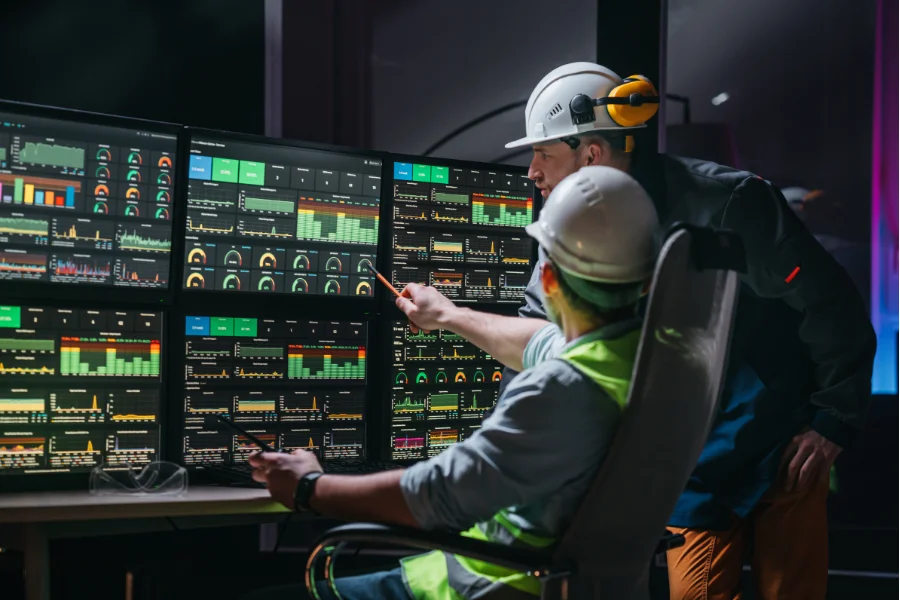
One of the key functions of an EMS is real-time energy monitoring. This means the system immediately detects abnormalities, such as sudden spikes in power consumption during unusual hours. With clear data visualization, you can easily understand what’s happening at any moment.
Benefits of monitoring and visualization include:
- quick anomaly detection – immediate identification of abnormalities in energy use;
- intuitive data interpretation – graphical presentation makes analysis easier;
- ability to react quickly – rapid action in critical situations;
- improved process management – real-time insights support operational optimization.
Energy Reporting and Energy Data Analysis
An Energy Management System (EMS) also functions as an advanced analytics tool. It generates detailed energy reports – daily, weekly, monthly – showing how and when energy is used in your company. These reports enable deep analysis and reveal hidden patterns and inefficiencies.
Examples of energy data analysis applications:
- identifying unnecessary consumption – e.g., increased power usage on weekends;
- detecting excessive machine operation – analyzing device operating times;
- production process optimization – adjusting schedules to actual demand;
- reducing operational costs – eliminating unnecessary energy expenses.
Control and Exceedance Alerts
An EMS acts like a digital power guardian, ensuring that energy consumption does not exceed set limits. When usage approaches the threshold, the system can automatically shut down selected devices to prevent additional charges. Alerts and notifications provide real-time warnings about potential threats.
In summary, an EMS enables:
- monitoring usage limits;
- automatic preventive actions;
- real-time alerts;
- protection against additional costs.
If you’re considering EMS, start with a discussion with our expert
During the Free 360 Workshop, we’ll identify where you’re losing energy and how quickly you can change that.
Benefits of Implementing an Energy Management System (EMS)
Implementing an EMS (Energy Management System) offers real potential to improve energy and operational efficiency. EMS provides precise control over energy consumption, with the primary goal of optimizing energy resource usage.
In practice, this means:
- lower energy bills,
- greater control over energy processes,
- greater energy independence.
With features such as automatic consumption control and remote data access, an EMS becomes not only a technical tool but also a strategic support system for daily company management.
Reducing Operational Costs and Energy Consumption
One of the most important benefits of implementing an EMS is the significant reduction of energy costs and overall energy use. The system enables continuous monitoring of energy parameters, allowing for quick detection of inefficiencies and immediate corrective action.
Example: In a production plant, an EMS can reveal that certain machines draw energy even when idle, generating unnecessary costs. Eliminating such waste directly translates into financial savings.
As a result, the company:
- reduces operational expenses,
- increases process efficiency,
- gains competitive advantage.
Increasing Energy Efficiency and Independence
An EMS is also key to enhancing energy efficiency and increasing independence from external power suppliers. How?
An EMS can be integrated with renewable energy sources such as:
- photovoltaic panels,
- wind turbines,
- energy storage systems.
This allows a company to partially or fully reduce reliance on external electricity suppliers.
Energy Management Automation and Remote System Access
Modern EMS solutions offer features that were once available only to the largest corporations. Today, medium and small businesses can access them just as easily.
Automation enables dynamic adjustment of energy consumption to current needs, eliminating waste and increasing efficiency. Meanwhile, remote system access allows full control of energy use from anywhere in the world – all you need is an internet connection.
For companies with multiple locations, this is a major advantage because it:
- enables centralized energy management,
- allows quick response to irregularities,
- increases operational flexibility,
- supports implementation of innovative solutions.
Key Components of an EMS
An EMS is more than just software – it is a complete ecosystem, an intelligent network of devices working together as a unified, efficient system. Its key components include:
- energy meters,
- current transformers,
- data concentrators,
- analytics platforms.
Together, they form an integrated structure enabling real-time energy management.
How does this work? For example, in a production facility, the system may detect that a machine is operating less efficiently than usual. It can then suggest service intervention before a failure occurs. Such proactive control leads not only to savings but also to greater process stability.
Energy Meters and Current Transformers
At the frontline of an EMS are energy meters, which accurately record electricity consumption. These devices form the basis of reliable analyses and informed energy management decisions.
Working alongside them, current transformers allow safe measurement in high-current environments, protecting both devices and users.
Their combined operation forms a precise measurement system. Example: in a production plant where energy use fluctuates depending on machine cycles, meter and transformer data help:
- identify peak consumption periods,
- analyze consumption trends,
- implement optimization actions,
- increase overall energy efficiency.
Data Concentrator as the Central Information Hub
The data concentrator is the heart of the EMS. Its tasks include:
- collecting data from meters, sensors, and other measuring devices,
- initial data processing,
- transmitting information to the main EMS platform.
It serves as a digital bridge between physical infrastructure and EMS software.
Software and User Interfaces
A modern EMS cannot function without advanced software and user interfaces. These tools allow users to:
- monitor energy use in real time,
- analyze historical data,
- identify areas requiring optimization,
- generate reports and alerts in real time.
Integrating EMS with Other Technologies
EMS integrates exceptionally well with modern technologies such as:
- the Internet of Things (IoT) – enabling data collection from many devices in real time,
- SCADA systems – allowing remote control and supervision of industrial processes,
- renewable energy sources (RES) – supporting sustainable energy management.
This synergy enables not only continuous monitoring but also intelligent energy management based on analytical insights. Example: a production plant can identify peak consumption hours and adjust machine schedules accordingly. This translates into real financial savings.
Environmentally, EMS systems offer even more – allowing both companies and households to reduce CO₂ emissions while gaining competitive benefits.
Integrating EMS with SCADA and MES
Integration of EMS with SCADA and MES is revolutionary for industrial energy management.
SCADA (Supervisory Control and Data Acquisition) enables real-time monitoring and control of processes. Combined with EMS, SCADA allows immediate responses to changes in energy consumption.
MES (Manufacturing Execution System) manages production in real time. Integrated with EMS, it synchronizes production data with energy consumption information.
Effect? The ability to reduce energy consumption in non-critical areas without affecting production quality, even during peak tariff hours.
When combined with ERP systems and IoT platforms, this leads toward fully automated energy management.
Using Dynamic Energy Tariffs
Many companies don’t realize that electricity prices vary throughout the day. A growing number of suppliers offer dynamic tariffs based on time, season, or grid load. An EMS can intelligently adjust energy consumption by shifting energy-intensive processes to hours when electricity is cheaper.
Practical Aspects of EMS Implementation
Implementing an EMS is not just a technological task but a complex process requiring precise planning and flexibility. The key is aligning new solutions with existing infrastructure. Where to start? With an energy audit that identifies the greatest losses and potential savings.
Only then can appropriate technologies and devices be selected. The new system must work seamlessly with existing solutions, often requiring upgrades or replacements. Only a well-aligned infrastructure ensures accurate real-time data essential for effective energy management decisions.
5 Implementation Stages and Technical Requirements
EMS implementation consists of several essential stages, each critical to overall success:
- Energy audit – serves as a roadmap, identifying loss areas and opportunities.
- Installation of measuring devices – enables real-time monitoring of energy use across operations.
- System configuration – ensures that data is accurate, easy to analyze, and ready for reporting.
- Integration with IT infrastructure – often requires upgrades to achieve full compatibility.
- Commissioning, monitoring, and optimization – final steps that ensure the system works as intended and delivers real benefits.
Does Implementation Require Replacing Measurement Infrastructure?
This question arises during nearly every planning stage – and rightly so. Effective EMS operation often requires upgrading the existing measurement infrastructure. Old meters and outdated sensors cannot provide real-time data, making analysis and rapid response difficult.
Replacing infrastructure is an investment in precision, control, and better decision-making. Modern measurement devices enable accurate tracking of energy consumption, translating into real savings.

How Fast Does an EMS Investment Pay Back?
An EMS investment can pay for itself in as little as 2–5 years, depending on organizational scale and energy consumption. Beyond lowering bills, EMS significantly improves control over processes and operational efficiency.
In an era of unstable energy markets and increasingly demanding regulations, EMS is not just an investment – it’s a strategic step toward the future. It gives companies an advantage today, tomorrow, and in the long term.
21st-Century Energy Monitoring
What does the future hold? Is this just the beginning of an energy revolution? Innovations such as:
- artificial intelligence (AI),
- blockchain technology,
- process automation,
- advanced predictive analytics
may dramatically change how we manage energy. Will the day come when EMS is as common as home Wi-Fi? One thing is certain: the future belongs to those who not only measure but also know how to use every watt wisely. EMS is the future of sustainable energy management.
Start monitoring energy the way modern production plants do it. Contact us – we’ll show you how to implement an EMS step by step.