

AVEVA Industrial Software Platform: What AVEVA System Platform Does and When to Implement It
AVEVA industrial software platform helps you assess whether your current production supervision setup is still enough, or whether you need a broader environment for working with data, alarms, and visualization. After reading this article, you will know what AVEVA System Platform does, where it can bring the most value, and how to start without making the first implementation scope too large.
This article is for people responsible for automation, production, maintenance, IT/OT, or industrial systems development. It will be especially useful if your plant runs several lines, uses different screen standards, relies on manual reports, or needs too much time to analyze downtime.
What is the AVEVA industrial software platform?
AVEVA System Platform is an industrial software platform used to build HMI, SCADA, MES, and IIoT applications. It helps collect data from processes, equipment, and plant systems, then organize that data into a model that operators, automation engineers, and production leaders can use in daily work.
The main change is in how the plant is described. Instead of creating separate screens and tag sets for each machine, the AVEVA industrial software platform lets you describe production through objects: a line, pump, tank, conveyor, process station, furnace, or packaging machine. Each object can have its own parameters, alarms, history, graphics, and logic.
A well-built standard can be reused later. That reduces manual work when adding new lines, areas, or sites. If your company is growing and you do not want every project to start from scratch, this can make a real difference.
When may a standard SCADA system no longer be enough?
A traditional SCADA system works well for process supervision, status visualization, and alarm handling. Over time, expectations often grow. You may need a shared standard across multiple lines, context for historical data, easier system development, and faster problem analysis.
You will usually notice the signals quickly:
- each line looks different on operator screens,
- there are many alarms, but it is hard to separate important ones from secondary ones,
- reports still require spreadsheets and manual updates,
- batch, order, and downtime data do not connect into one clear view,
- launching a similar line means repeating work you have already done,
- automation, production, and IT teams rely on different sources of information.
At that point, an AVEVA industrial software platform starts to make sense. You still work close to shop-floor data, but you structure it so that the operator, automation engineer, and shift manager can look at the same process from the perspective of their own tasks. No guessing where the right information is stored.
How does the AVEVA industrial software platform work?
The core of the solution is an object model. In AVEVA documentation, Application Server and Galaxy Repository play an important role. Galaxy Repository is the system configuration repository where the application model, templates, objects, and relationships between them are stored.
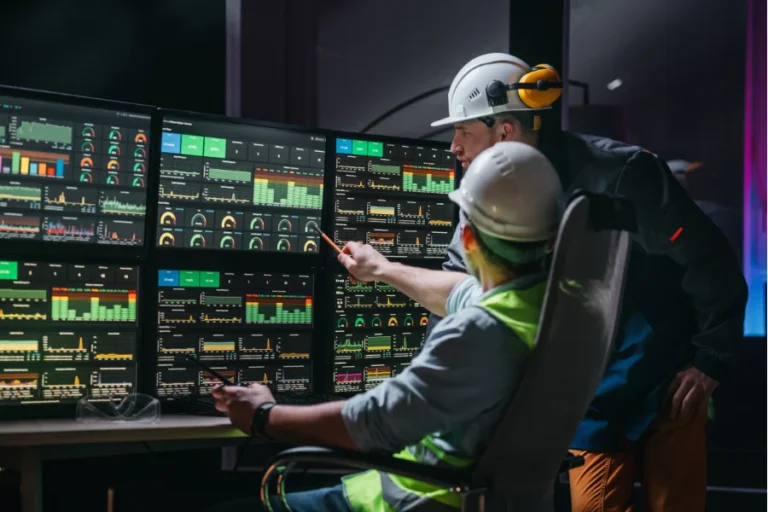
AVEVA OMI is responsible for the operator layer. It allows teams to create views for specific roles, areas, and devices, so the operator does not have to see everything at once. A well-prepared screen leads them to the information that matters at that moment: process status, an alarm, a warning, a trend, or an area that needs action.
That structure reduces the number of one-off solutions. Names, graphics, alarms, and objects can follow a shared standard, which becomes more important as the number of lines grows. A system that looks simple at first can become difficult to maintain after a few years, especially when each part was built in a slightly different way.
What does the object model change in a plant?
The object model helps organize how your company describes production. This is not about prettier screens. It is a decision that affects how the system can grow over the next several years.
| Area | What the company gains |
|---|---|
| Standards | similar devices and lines follow the same description |
| Maintenance | a template change can reduce work across many similar objects |
| Alarms | events are assigned to devices, areas, and processes |
| Analysis | historical data is easier to connect with a batch, shift, or line |
| Growth | new areas can be built on a proven model |
According to AVEVA materials, engineering effort can be reduced by up to 80%. This number should be read carefully, because the vendor refers to the potential created by standards and reusable elements, not to a guaranteed result in every project. You will usually see the biggest effect where there are repeatable lines, many similar devices, and a clearly defined standardization method.
For that reason, the AVEVA industrial software platform works best when the plant is ready to define common rules before expanding the system. The model has to reflect real production, not just a list of tags.
AVEVA system platform example: a plant with several packaging lines
A plant has four packaging lines. Order data is stored in ERP, operating parameters are in PLCs, downtime is tracked in spreadsheets, and alarm history sits in local SCADA. The shift manager sees results with a delay, the automation engineer checks several places to find causes, and the daily report still requires manual input.
After implementing AVEVA System Platform, each line can be described with the same model. The packaging machine, labeler, checkweigher, and conveyors have their own objects, and alarms are assigned to the right devices. Line history is connected with the batch, product, and shift.
As a result, the conversation about a problem becomes shorter. The manager can see faster whether stoppages relate to one machine, a specific packaging format, or the whole line. The automation engineer does not have to search through several projects to find the right tag, while maintenance can compare recurring failures and check whether service work is removing the cause or only the symptom.
A good pilot should show changes in alarm response time, the number of manual reports, downtime analysis time, recurring issues, preparation time for another similar line, and the number of exceptions from the standard. That is why it is worth tracking changes from the beginning.
This kind of AVEVA industrial software platform example is useful because it shows the real decision behind the project: the company is not just adding new screens. It is creating one way to describe machines, alarms, events, and production context.
When does implementation make sense, and when is it better to start smaller?
AVEVA System Platform does not have to be the first choice for a simple installation with one machine and a local HMI panel. In that case, traditional visualization may be enough.
Implementation is worth considering when the plant has several lines, multiple data sources, growing reporting requirements, or a plan to develop its OT/IT architecture. Another good signal is the moment when the company wants to unify HMI/SCADA standards before future investments.
The highest risk is usually at the start of the project. If the data model, naming, alarms, and system responsibilities are described too loosely, the platform will not solve the core issue. It will only become another layer over the old structure.
The first stage should help you answer these questions:
- Which data is the hardest to access today?
- Who makes decisions based on that data?
- Which reports are still created manually?
- Where do HMI/SCADA standards differ between lines?
- How should the system grow over the next 2-3 years?
Only then is it worth choosing the pilot scope, licenses, architecture, and schedule. Order matters, because a poorly chosen first project can discourage the team from a solution that may still be the right direction.
A well-planned AVEVA industrial software platform project usually starts small enough to control risk, but clearly enough to prove value. One line, one area, one model, and measurable outcomes are often better than a wide rollout with unclear ownership.
How can explitia help without forcing a ready-made scheme?
A conversation about AVEVA System Platform should start with the plant, not with a feature list. First, you need to see where data is created, who uses it, which decisions take too long, and which standards are still only informal.
At explitia, we usually start these conversations by reviewing the OT/IT architecture, data sources, manual reports, alarms, and screen standards. That makes it easier to assess whether the AVEVA industrial software platform is truly a good fit for your plant, or whether it would be better to organize a smaller area first.
If the audit shows that AVEVA System Platform fits your situation, the next step can be small: one line, one area, one object model, and clear success measures. This kind of start reduces risk and gives you a stronger basis for deciding on a wider implementation.
See how AVEVA System Platform could work in your plant.
What should you remember before making a decision?
The AVEVA industrial software platform brings the most value where local production supervision is no longer enough, and the company wants a shared language for data, alarms, devices, and reports. It is a good fit for organizations that need order before they scale.
Start by identifying which production decisions are delayed today because data is scattered or lacks context. The answer will show whether AVEVA System Platform is the right direction and which area is the best place to begin.
FAQ
Is AVEVA System Platform a SCADA system?
AVEVA System Platform can function as a SCADA environment, but it is broader than a traditional SCADA system. It lets you build an object model of the plant, standardize HMI/SCADA applications, and develop the system for alarms, historical data, reporting, and integration with other systems.
What is the AVEVA industrial software platform in simple terms?
The AVEVA industrial software platform organizes production data and shows it in the context of a process, device, line, or plant. It helps teams understand faster what is happening on the shop floor and where action is needed.
Is AVEVA System Platform suitable for a small plant?
Yes, if the plant is planning growth, wants to standardize several lines, or needs to integrate production data. For a very simple installation, a local HMI or traditional SCADA may be enough.
Where should an AVEVA System Platform implementation start?
Start by describing processes, data sources, current systems, screen standards, and the biggest information gaps. Then choose a pilot with a clear scope and measurable outcome.
Can AVEVA System Platform integrate with MES or ERP?
Yes, it can be part of a broader OT/IT architecture. The integration scope should be defined before implementation: which data should flow between systems, which system is the source of truth, and who is responsible for maintaining the connections.
See what other AVEVA solutions can support your production.