

Hannover Messe 2026: 7 Decisions for Your Manufacturing Plant
If you left Hannover Messe 2026 with your head full of terms like AI, robotics, Manufacturing-X, Digital Battery Passport, automation, and production data, now is the time to ask a more useful question:
Which of these topics will change something in your plant within the next 12 months?
Think Tech Forward: Hannover Messe 2026
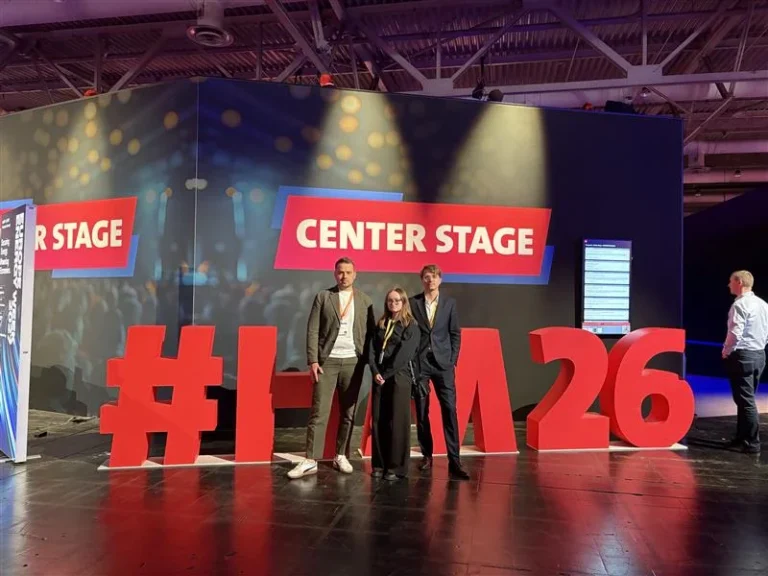
Hannover Messe 2026 took place from April 20 to 24, 2026, under the theme “Think Tech Forward.” The event brought together about 110,000 visitors, around 3,000 exhibitors, and 40% of attendees came from outside Germany. The scale was impressive, but for manufacturers, the numbers are not the main point. What matters more is what you can take back to the factory.
The biggest lesson from the show is simple: the technology for manufacturing digitalization is already available.What matters now is whether your company can organize its data and make better decisions.
In this article, we are not focusing on the definition of Manufacturing-X or the Digital Battery Passport. We covered those topics separately in articles we invite you to read: Manufacturing-X: What Is It?, data control in Manufacturing-X, and Digital Battery Passport at Hannover Messe.
Here, we focus on what a manufacturer should do after Hannover Messe 2026 to turn inspiration into action.
Hannover Messe 2026 for Industry: Less Technology for Its Own Sake, More Decisions
A lot of the discussion in Hannover focused on AI, robots, automation, energy, digital product passports, and data exchange between companies. That is expected. Hannover Messe always shows where industry is heading.
From a manufacturing plant’s point of view, a list of technologies does not change much on its own. Trendy terms will not help you unless you can answer questions like:
- Where are we losing time?
- Where are we losing data?
- Where do we lack the full product history?
- Which reports are still created manually?
- Which decisions rely on delayed information?
- Which customer requirements will be hard to meet in one or two years?
That is why the lessons from Hannover Messe should be read through the lens of daily factory work, not only through what looked good on an exhibition stand.
1. AI in Manufacturing Starts with Data, Not the Model
AI was one of the most visible topics at Hannover Messe 2026. Exhibitors showed systems for data analysis, failure prediction, operator support, production planning, quality control, and energy optimization.
For many manufacturers, this direction is attractive. The problem is that AI will not fix poor data quality if the data is incomplete, inconsistent, or stored across too many places.
If production data sits in MES, some information is in ERP, quality results are in Excel, failure history is in a separate system, and part of the knowledge is still in operators’ heads, AI will have limited room to work.
Before asking how to implement AI in your factory, ask:
- Are machine data collected automatically?
- Can process parameters be linked to a specific batch?
- Are quality results assigned to the product?
- Is it clear where the data in a report comes from?
- Are data available when people need them?
Example
You have a line where defects are increasing. You want to check whether the problem comes from a material batch, machine settings, operator shift, process temperature, or a specific supplier.
If the data are connected, the analysis may take hours. If they are scattered, the work turns into searching files, asking for reports, checking paper forms, and talking to people who may remember something, or may not.
AI can help, but first it needs an organized view of the process.
Decision after Hannover Messe 2026: choose one quality or production problem and check which data are needed to analyze it. That is a better start than a broad AI project.
2. Traceability Is No Longer Only About Quality
For years, traceability was mostly associated with complaints, audits, and customer requirements. After Hannover Messe, it is clear that its role is broader.
Product traceability is becoming the basis for:
- digital product passports,
- environmental footprint reporting,
- batch and component control,
- faster complaint analysis,
- secure data exchange with customers,
- compliance with regulatory requirements,
- better cooperation across the supply chain.
If you cannot recreate the history of a product, you will struggle not only with quality, but also with questions from customers, auditors, and business partners.
A Simple Test for Your Plant
Take one finished product or batch and try to answer:
- Which components was it made from?
- Which suppliers did they come from?
- Which workstations did it pass through?
- Which process parameters were linked to it?
- Which quality results are connected to it?
- Who performed the main operations, and when?
- How long does it take to collect this information?
If the answer takes several days, traceability is a good candidate for your first project after the show.
Decision after Hannover Messe 2026: check how long it takes to recreate the full history of one batch. The answer will show where you really are.
Want to talk more about the lessons from Hannover Messe 2026? Get in touch with us.
The show brought many new ideas and important topics around industrial technology. It can be hard to sort through all of them and decide what matters most for your plant. We can help. Let’s talk.
3. Digital Battery Passport Shows the Direction for Many Industries, Not Only Batteries
The Digital Battery Passport was one of the topics strongly present in conversations about product data. In the European Union, the requirement for a digital battery passport is expected to cover selected battery types from 2027, including batteries for electric vehicles, LMT batteries, and industrial batteries above 2 kWh.
There is also a clear lesson here for manufacturers outside the battery sector.
The battery passport shows what the future of product data may look like. Material origin, production parameters, usage data, service history, environmental impact, and recycling information may increasingly be linked to a specific product.
This does not mean every company must implement a digital product passport today. Still, it is smart to check whether the data needed for such a passport are already created in the process.
Where Do Product Passport Data Come From?
| Data | Where they usually come from | What to check in your plant |
|---|---|---|
| Material origin | ERP, warehouse, purchasing | Is the material batch linked to the product batch? |
| Process parameters | machines, SCADA, MES | Are data assigned to the product or order? |
| Quality results | quality, lab, test stations | Are results available digitally and fast enough to act? |
| Environmental data | utilities, energy, ESG reporting | Can energy use be linked to a product or line? |
| Service data | maintenance, service, customer systems | Is event history described in a way that can be analyzed? |
You can read more about how the Digital Battery Passport appeared at the show and our role in it here: Digital Battery Passport at Hannover Messe.
The main lesson is clear: a product passport is not created at the end of the process. Its data are created on the line, at the machine, in the warehouse, and during quality control.
Decision after Hannover Messe 2026: choose one product and check which data required for a future passport you already have, and which data are still collected manually.
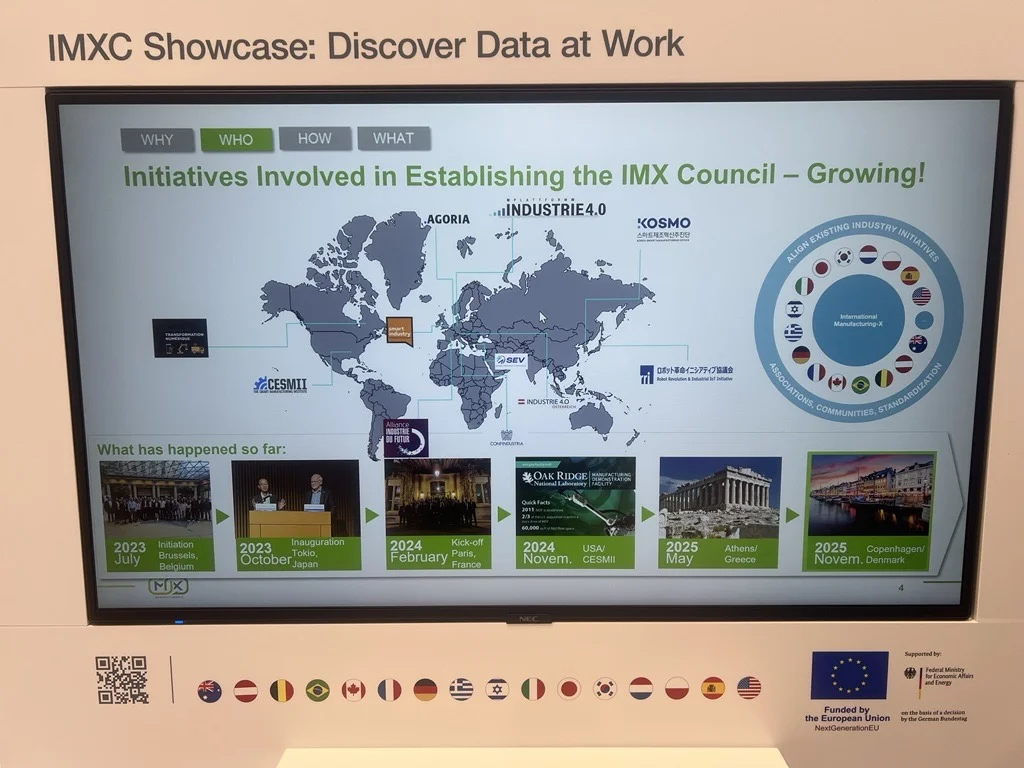
4. Manufacturing-X Changes the Conversation About Data Exchange
Manufacturing-X shows that industry is moving more strongly toward cooperation based on data. This includes not only data inside one company, but also data shared between manufacturers, suppliers, customers, service providers, and supply chain partners.
This topic can raise real concerns. On one side, customers and partners expect more transparency. On the other, manufacturers do not want to share full knowledge about processes, recipes, parameters, or suppliers.
That is where Manufacturing-X matters: data exchange needs control.
We covered this in more detail in Manufacturing-X: What Is It? and data control in Manufacturing-X. From a manufacturer’s point of view, your company should know which data it can share, with whom, and to what extent.
Example
A customer asks about the environmental footprint of a batch. An auditor asks for component history. A supplier wants feedback on the quality of a delivered part. A service partner needs operating data.
Each person needs different information. Not everyone should see everything.
That is why companies need to organize not only the data itself, but also access rules.
Define:
- which data are internal,
- which data can be shown to customers,
- which data can be shared with suppliers,
- which data are required by regulations,
- who approves the scope,
- where the source of truth is.
Decision after Hannover Messe 2026: prepare a simple map of the data your company may share externally. Start with one process or one product group.
5. Automation Without Context Does Too Little
Hannover Messe 2026 showed many solutions in automation, robotics, and control systems. This is a good direction for companies that want to increase productivity, reduce errors, and improve process repeatability.
But automation alone does not give you the full production picture.
A plant may have robots, sensors, controllers, and a new line, and still not know why defects are increasing or where time is lost during changeovers.
Automation data tell you what happened. Quality data tell you whether the product met the requirements. Traceability data show what the product was made from. Maintenance data describe the condition of machines. Only after connecting these sources can you make better decisions.
What Should You Check?
Beyond having machine data, you need to understand their context. Check whether you know:
- which order they are linked to,
- which product they refer to,
- which component batch they are connected with,
- whether they affected quality results,
- whether they are available to the people making decisions.
Decision after Hannover Messe 2026: start by connecting process, quality, and product data for one selected problem.
6. Energy Becomes Part of the Manufacturing Conversation
Energy was another strong topic at the show. The conversations covered energy infrastructure, green hydrogen, energy storage, and optimization of industrial media consumption.
For manufacturers, this changes how costs are viewed. A monthly energy bill says too little. What matters more is knowing:
- how much energy a specific line uses,
- which products consume the most energy,
- how changeovers affect media use,
- whether downtime creates hidden costs,
- whether production planning includes energy data,
- whether energy data can be connected with quality and OEE.
This matters not only for finance. Energy consumption data will increasingly be needed in conversations with customers, auditors, and business partners.
If a company wants to talk about the environmental footprint of a product, it needs to go below the level of the whole factory.
Decision after Hannover Messe 2026: check whether you can link energy consumption to a line, order, or product. If not, this is a good pilot topic, for example for an EMS system.
7. The Best First Step Is a Small Project with a Clear Goal
After the show, it is easy to feel that everything needs to change at once: AI, robotics, data, product passports, Manufacturing-X, ESG, energy, traceability.
That is too much for a starting point. A smaller project often works better when it answers a specific problem and has a measurable outcome.
A good project inspired by Hannover Messe could aim to:
- shorten complaint analysis from several days to a few hours,
- recreate batch history without manual data collection,
- connect quality data with process parameters,
- collect data from one line without Excel sheets,
- prepare product passport data for one product group,
- link energy consumption with a selected process,
- check which data can be safely shared with customers.
These goals are easier to defend with management, production, and finance. They are specific, business-focused, and do not need a large narrative.
If you want to see what such a project could look like from the system side, the natural next step may be a conversation about the explitia Production Portal or product traceability in serial production. First, choose the problem you want to solve.
Decision after Hannover Messe 2026: choose one process, one line, or one product. Define what you want to improve within 90 days.
Main Takeaways from Hannover Messe 2026: A Simple Test
If you do one thing after Hannover Messe 2026, make it this simple test: choose one product and try to recreate its full history.
- Which components was it made from?
- Which workstations did it pass through?
- Which process parameters were linked to it?
- What did the quality results look like?
- How long does it take to collect this information?
If the answers come quickly, you have a strong starting point for AI, product passports, and data exchange.
If they require many people, files, and manual checks, you also have a good starting point: now you know where to begin.
A Short Lesson to Take Away from the Fair
Hannover Messe 2026 showed that the biggest challenge for manufacturing companies is no longer access to technology, but the ability to organize data and turn it into decisions. AI, traceability, Manufacturing-X, digital product passports, automation, and energy management only make sense when data from machines, quality, materials, processes, and systems is consistent, accessible, and linked to a specific product or order. The best step after the fair is choosing one problem, such as complaints, batch history, manual reporting, or energy consumption, and checking what you can improve most efficiently.
FAQ: Hannover Messe 2026 and Lessons for Industry
What were the main topics at Hannover Messe 2026?
The main topics at Hannover Messe 2026 included industrial AI, automation, robotics, production data, energy infrastructure, hydrogen, Manufacturing-X, and digital product passports.
What does Hannover Messe 2026 mean for manufacturing companies?
For manufacturing companies, it means a stronger need to organize data from machines, processes, quality, materials, and energy. Without that, it becomes harder to implement AI, traceability, digital product passports, and safe data exchange with partners.
Where should you start after Hannover Messe 2026?
Start with one problem. It may be a complaint, manual reporting, missing batch history, a long audit process, or lack of energy consumption data. Then check which data are needed, where they are today, and what can be improved within 90 days.
Is Manufacturing-X only for large companies?
No. Large companies will feel pressure around data exchange sooner, but smaller plants will also be asked more often for information about batches, components, quality, material origin, or environmental footprint. Manufacturing-X shows a way of thinking about data that will matter across supply chains.
Why is traceability so important after Hannover Messe 2026?
Traceability helps manufacturers analyze complaints faster, pass audits, answer customer questions, and prepare data for digital product passports. It is one of the most practical areas for companies that want to start organizing production data.
Want to learn more about Hannover Messe 2026? Let’s talk.
Want to learn more about Hannover Messe 2026? Let’s talk.