



How to Increase the Manufacturing Plant Productivity
How can a manufacturing plant increase productivity without an immediate investment in new machines, extra shifts or a larger technology park? One of the most effective first steps is to make better use of the data that is already created in production: data from machines, systems, operator stations and shift reports.
Production monitoring, automatic reporting, OEE analysis and real-time data visualization help identify downtime faster, reduce losses and make better operational decisions. This article shows which areas are worth measuring and how IT systems support higher plant efficiency.
What Is Manufacturing Plant Productivity?
Manufacturing plant productivity shows how effectively a company uses available resources: machines, people, materials, energy and working time. It covers more than a higher output. It also means better results with fewer losses, less downtime, fewer quality errors and less manual administration.
An increase in productivity may mean shorter order completion times, higher machine availability, fewer failures, better production planning and a lower unit cost of manufacturing. To improve the process, you first need to measure what is really happening on the production floor.

Higher Productivity When Conditions Change
In a production market that changes quickly, fast access to reliable data is one of the basic conditions for effective plant management. IT systems that monitor main production process indicators in real time support managers, shift leaders, maintenance teams and production planners.
With current and historical data, you can detect deviations faster, analyze the causes of problems and make decisions based on facts, not only on paper reports or manually filled spreadsheets.
How to Measure Production Productivity
Plant productivity cannot be improved effectively without measuring the right indicators. Manufacturing plants most often analyze OEE, machine availability, performance, quality, the number and duration of downtime events, production plan completion, changeover time and the level of defects.
The OEE indicator is especially useful because it shows how effectively machines and production lines are used. Analysis of its components, availability, performance and quality, helps show whether the biggest problem is machine failure, slow line operation, micro-downtime, changeovers or quality losses.
Only after these data have been collected can you point to specific areas that need optimization and check which actions bring measurable effects.
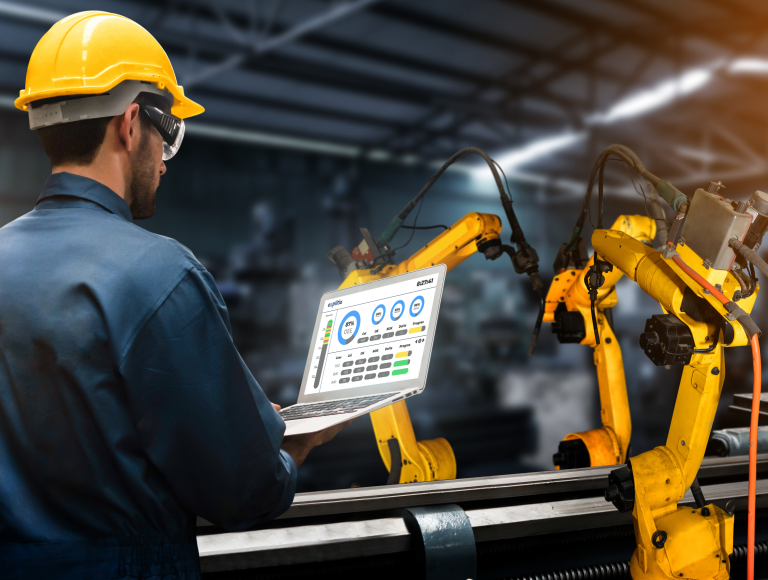
Plant Productivity Monitoring
Plant Productivity and the Production Portal
By using the Production Portal module responsible for production status visualization and automatic reporting, you can get information such as:
- production counter,
- OEE split into availability, performance and quality,
- downtime reasons,
- hour-by-hour operating status,
- Pareto charts, for example the top 5 most frequent or longest downtime events.
These data help answer questions that have a direct impact on plant productivity:
- which machine generates the most downtime,
- which failures repeat most often,
- how performance changes between shifts,
- where the largest production losses occur.
Productivity monitoring should do more than present data. Its value comes from faster reaction time for operators on the production floor and for people responsible for process analysis, maintenance and production planning.
A well-prepared monitoring view also helps find recurring losses. For example, if a Pareto chart shows that a few downtime reasons account for most stoppages, the team can focus on the areas that matter most instead of reacting only to single incidents.
How to Increase the Productivity of a Manufacturing Plant
mproving productivity should start with finding the largest losses. The problem is usually not the lack of data itself, but the lack of automatic collection, clear organization and presentation in a form that decision-makers can use.
It is worth focusing on several actions:
- automatic collection of data from machines and production systems,
- OEE analysis for individual lines, machines and shifts,
- monitoring downtime reasons and downtime duration,
- reducing manual data entry,
- faster detection of deviations from the production plan,
- comparing the efficiency of machines, lines and plants,
- giving current data to people responsible for operational decisions.
With these changes, production optimization becomes a regular process, not a one-time analysis performed only after a serious problem has occurred.
Productivity also depends on cooperation between departments. Production, maintenance, quality, logistics, planning and management should work with the same data. A shared view of the process makes communication easier and helps teams react faster.
Benefits of Automatic Production Reporting for plant productivity
Automatic production reporting reduces many problems caused by manual data entry. Operators and shift leaders do not need to rewrite information from paper forms, and people responsible for analysis receive data sooner and in a more ordered form.
This is especially useful in plants where decisions must be based on the current situation on the production floor, not on reports prepared after the shift has ended.
The main benefits include:
 Better use of staff time by reducing manual document rewriting.
 Fewer errors caused by manual data entry.
 Constant access to current and historical indicators.
 Prediction of future failures based on historical failure data.
 Lower production costs and higher productivity through access to reliable data.
 Better production planning, for example through comparison of OEE indicators for different machines.
Automatic reporting also makes historical comparison easier. A plant can check whether introduced changes have really shortened downtime, increased OEE, reduced errors or improved the use of available resources.
Production Status Visualization: Why Is It Worth It?
| Better communication and faster reaction through real-time data, |
| a quick view of what is happening on the production floor at a given moment, |
| access to information from plants located in another city, country or region. |
Production status visualization helps teams quickly check what is happening on the production floor. One screen can show the current machine status, plan completion, number of produced pieces, downtime, alarms and the most useful efficiency indicators.
This means shift leaders, production managers and maintenance teams do not need to wait for a report after work has finished. Information is available in real time, which shortens reaction time and improves communication between teams.
Visualization is especially useful in companies with several lines, departments or production plants. Access to data from different locations helps compare results, identify problems faster and apply good working methods in other areas.
Example: Using Data to Improve Manufacturing Plant Productivity
For example, one production line may lose several dozen minutes per shift because of short, recurring stoppages. Without a monitoring system, these events may be hard to see because each stoppage lasts only a few minutes.
After collecting the data, the total impact of micro-downtime becomes clear. Analysis of the reasons may point to a lack of components, frequent machine adjustments or a recurring operator error. The plant can then introduce a specific corrective action and check whether OEE or the number of produced pieces has improved after the change.
FAQ: Manufacturing Plant Productivity
How to increase manufacturing plant productivity?
A manufacturing plant can increase productivity by monitoring machine work, analyzing OEE, reducing downtime, using automatic production reporting, reacting faster to failures and making decisions based on current process data.
Which indicators help measure manufacturing plant productivity?
The most useful indicators include OEE, machine availability, performance, quality, the number and duration of downtime events, changeover time, number of produced pieces and production plan completion.
Why does manual reporting reduce efficiency?
Manual reporting takes time, increases the risk of errors and delays access to information. Automatic reporting helps teams analyze results faster and react to problems while the shift is still in progress.
How does data visualization affect plant productivity?
Production data visualization shows the current status of machines, lines and processes in real time. Teams can notice problems faster, communicate more clearly and make better operational decisions.

Do you want to check where your plant loses productivity and which data should be measured first?
Talk to us about production monitoring, OEE, automatic reporting and real-time data visualization. We will help choose a system that fits the real needs of your production process.