

Top MES Software: How to Choose the Best System for Your Plant
The top MES software solutions differ significantly, and those differences cannot be reduced to a simple feature checklist. If you are responsible for manufacturing and looking for a solution for your plant, focus first on how the system collects data, integrates with ERP and machines, handles traceability, supports future expansion, and how much ongoing work it will require after implementation.
That is why we have prepared this comparison to help you make a more informed decision and choose a system that is not necessarily packed with the most features, but instead includes exactly the capabilities your operation needs.
Top MES software solutions worth knowing
The market includes both comprehensive global platforms and solutions developed by Polish vendors. Some of the manufacturing execution systems worth considering during your research include our explitia Production Portal, Siemens Opcenter Execution, AVEVA Manufacturing Execution System, DELMIA Apriso, FactoryTalk ProductionCentre, Comarch MES, XPRIMER.MES, and IPOsystem.
This list is not a ranking by market share. There is no reliable, publicly available source showing the number of implementations for every MES platform in Poland, so assigning these systems positions from first to tenth would be misleading.
Market share is not what matters most anyway. What matters is how well the system fits your processes, infrastructure, and the way your plant operates. The ISA-95 standard describes information exchange between business systems and manufacturing operations management. In practice, this includes data flows between ERP, MES, automation systems, quality systems, and operator workstations.
How to compare MES software without ending up with a feature checklist
A typical vendor presentation shows a dashboard, OEE, an operator screen, and reports. However, this type of demonstration tells you very little about how the system will perform in the specific conditions of your manufacturing process.
Before you start talking to vendors, select and describe one scenario from your own plant. It might include a production order sent from ERP, material picked from a specific lot, an operation completed on a machine, process parameters recorded, a quality inspection performed, and a rework process initiated.
Every system should be able to show you how it knows which material went into the product, who performed the operation, which machine was used, which parameters were recorded, what the inspection result was, and what happened after a nonconformance was detected. This kind of test will tell you much more about a system than a polished, preconfigured demo.
MES Fit Score: 7 criteria worth evaluating
Instead of creating a ranking of the best manufacturing execution systems, it is more useful to evaluate how well each solution fits your plant. A simple MES Fit Score can help.
| Criterion | What to evaluate |
|---|---|
| Manufacturing process | Can the MES handle the real production order flow, rework, scrap, downtime, and exceptions? |
| Data collection | Which information is collected automatically, and which data still has to be entered by an operator? |
| IT/OT integration | How will it connect to ERP, PLCs, SCADA, WMS, APS, or CMMS? |
| Traceability and quality | Can you reconstruct the history of a batch or serial number? |
| Flexibility | How easy is it to change a process, form, screen, or business rule? |
| Maintenance | Who will administer the system and make changes after implementation? |
| Scalability | Can you start with one production line or process and expand later? |
You can score each criterion from 0 to 3. However, the total score alone should not determine your decision. If a system fails to meet a critical requirement, strong performance in the remaining areas will not solve that problem.
Which MES systems should you consider?
explitia Production Portal
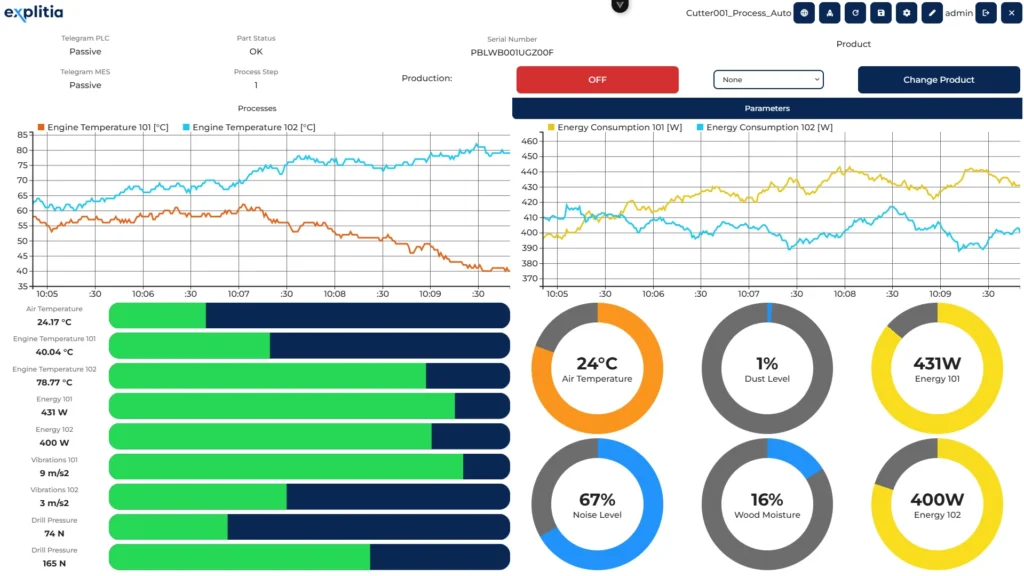
The explitia Production Portal includes functionality for production execution, data collection and visualization, digital operator instructions, traceability, SPC, and integration with existing systems and industrial automation. The solution can be expanded in stages depending on your plant’s needs.
Because of its modular structure and the ability to adapt the scope to what you need at a given time, this MES can be a good fit if you expect your requirements to grow or need a system that can be adjusted as your operation develops. Our system was also featured in a comparison published by Business Insider Poland.
Siemens Opcenter Execution
Siemens Opcenter includes solutions designed for different types of manufacturing. Opcenter Execution Discrete is developed for use cases including discrete manufacturing and complex assembly, while Opcenter Execution Process is intended for process manufacturing.
This solution is worth evaluating if you have extensive requirements and operate in a larger industrial environment. During your analysis, move beyond the Opcenter brand name and examine the specific product and functional scope being proposed.
AVEVA Manufacturing Execution System
AVEVA MES supports production execution, material tracking, product genealogy, quality control, and performance indicators such as OEE. The vendor also describes options for phased implementation and process standardization across multiple manufacturing sites.
It is worth considering if automation integration, production execution control, and multi-site operations are important to your organization.
MPDV HYDRA X MES
MPDV HYDRA X is an MES platform that supports manufacturing data collection and analysis, machine monitoring, OEE, quality management, traceability, and integration with ERP and industrial automation. It makes it possible to combine information about order execution, performance, and process history within one environment.
Consider it if automated shop-floor data collection, reducing manual reporting, and gradually expanding your MES scope are important priorities. During the demo, pay particular attention to integration with the machines and ERP systems you already use, as well as how the platform handles a real production scenario from your plant.
DELMIA Apriso
DELMIA Apriso from Dassault Systèmes is a MOM platform covering areas such as production execution, traceability, and operations synchronization. The vendor also positions it for projects involving multiple manufacturing sites.
It is worth considering for more complex requirements and initiatives focused on process standardization. At the same time, it is important to separate the functionality you actually need today from features that would only increase the size and complexity of the project.
FactoryTalk ProductionCentre
FactoryTalk ProductionCentre from Rockwell Automation is an MES platform supporting areas including manufacturing, quality, and compliance. The FactoryTalk portfolio also includes industry-specific solutions, for example for pharmaceutical and consumer goods manufacturing.
It is particularly worth evaluating if your plant already uses Rockwell technologies. In a mixed automation environment, you should also verify how the system communicates with equipment from other manufacturers.
Comarch MES
Comarch MES supports activities such as recording production tasks, operation times, materials, downtime, and selected quality data. The solution is connected with the broader Comarch ERP ecosystem.
It is a natural candidate for companies already using Comarch solutions. Before making a decision, however, verify whether the standard functionality is sufficient for your automation integration and manufacturing process requirements.
XPRIMER.MES
XPRIMER.MES from eq system collects data on process execution, resource utilization, and production order progress. The vendor’s portfolio also includes solutions related to IoT, traceability, and CMMS.
The system is worth considering if you want to connect several manufacturing operations management areas. One key point to determine is which data will flow into the MES automatically and which information will still need to be entered manually.
MES software comparison at a glance
| MES system | Primary use case |
|---|---|
| explitia Production Portal | Modular implementation, ERP and automation integration, traceability, SPC, and phased system expansion |
| Siemens Opcenter Execution | Complex industrial environments, discrete manufacturing, and process manufacturing |
| AVEVA Manufacturing Execution System | Production execution, product genealogy, quality, and standardization across multiple plants |
| DELMIA Apriso | Advanced MOM processes, traceability, and operations management across multiple sites |
| FactoryTalk ProductionCentre | MES for manufacturing, quality, and compliance, particularly in Rockwell Automation environments |
| Comarch MES | Production reporting and integration with the Comarch ERP ecosystem |
| XPRIMER.MES | Monitoring processes, resources, and production order progress, with links to IoT and CMMS |
How to choose MES software for your company
Before requesting proposals, write down three to five problems the system is expected to solve. These might include a lack of real-time production order status, manual reporting, traceability issues, delayed data in ERP, or time-consuming consolidation of reports.
Then turn each problem into a requirement that can actually be tested. Instead of writing a general requirement such as “we need better traceability,” define exactly what that should mean. For example: after entering a serial number, the user must be able to see the materials used, completed operations, inspection results, and process parameters without manually combining several reports.
This is one of the most practical approaches when determining how to choose MES software for a real manufacturing environment.
MES for a small manufacturer: focus on the scope of the first implementation
A smaller manufacturing company may face the same challenges with data, quality, and traceability as a large factory, while having a smaller project team, a different budget, and usually fewer resources available for maintaining the system after go-live.
That is why, when selecting an MES for a smaller manufacturer, you should evaluate the minimum implementation scope, licensing model, infrastructure requirements, integration scope, and the process for making future changes.
A small company needs a solution that matches both the scale of the problem and its ability to maintain the system. If the first priority is automated data collection from one production line and reliable downtime information, starting with that area can be the most reasonable approach.
MES integration with ERP and machines should be part of the selection process
Determine which data will be exchanged, which system will be the source of record, how frequently communication will take place, and what will happen if that communication is interrupted.
Before choosing a system, prepare a simple map of your most important data: production orders, routings, machine states, quantities produced, scrap, materials, inspection results, and process parameters. For each item, define the source, destination, frequency of exchange, and how errors should be handled.
This will give you a much clearer picture of the real scope of MES integration with ERP and industrial automation.
Ask every MES vendor these questions
- Which data can the system collect automatically from our machines and other systems?
- Which information will still need to be entered by operators?
- What happens if communication with ERP or a machine is lost?
- Can the system reconstruct the complete history of a batch or serial number?
- How does it handle rework and repeat inspections?
- Which changes can our own administrator make without vendor involvement?
- What does it take to extend the implementation to another production line or plant?
- Which parts of the proposal are standard product functionality, and which will be custom-developed for our company?
When several vendors answer the same questions, their proposals become much easier to compare.
Want to find out exactly which MES system will best meet your needs? Take advantage of a free workshop.
Who should be involved in selecting an MES?
The manufacturing director may lead the project from a business perspective, but the decision should also include input from IT, automation, quality, planning, and logistics.
Manufacturing defines how the work is actually performed, IT evaluates architecture and ongoing support requirements, automation specialists identify available data sources, and quality teams define requirements related to traceability and inspections. If one of these perspectives is missing, the resulting gaps often become visible only during implementation, and can quickly turn into significant problems.
How do you choose the best MES from several proposals?
First, eliminate solutions that fail to meet your critical requirements. Then apply the MES Fit Score and compare manufacturing processes, data collection, integrations, traceability, flexibility, maintenance, and scalability.
Finally, calculate the full cost: licenses or subscriptions, integrations, configuration, infrastructure, training, commissioning, support, and future modifications. If you do not know the cost of a particular item, mark it as unknown rather than assuming it is zero.
For larger projects, consider a pilot or Proof of Concept based on one process. If traceability is the main objective, test whether the system can reconstruct the complete history of a selected serial number. If ERP integration is the priority, test the full production order lifecycle, including what happens when communication fails.
This approach also makes it easier to assess the actual benefits of manufacturing execution systems instead of relying only on feature claims in vendor presentations.
What rule should you follow before choosing an MES?
Do not choose a system based on a vendor ranking. Instead, identify two or three solutions that meet your critical requirements and compare them using the same real-world process from your own plant.
The top MES software platforms may offer extensive catalogs of capabilities, but only alignment with your manufacturing processes, data, automation environment, and organizational workflow will show whether a particular solution is actually right for you.
If you have not yet documented your requirements, a good first step is an MES pre-implementation assessment that organizes your processes, data, and integration needs. This makes it easier to build a shortlist and discuss a specific project scope with vendors rather than sitting through generic product presentations.
Understanding this fit is ultimately more useful than trying to identify one universal list of the best manufacturing execution systems for every manufacturer.
FAQ
How much does an MES cost?
There is no single meaningful price that applies to every plant. Cost depends on the licensing model, functional scope, number of workstations or users, infrastructure, integrations, customization, and support. When comparing proposals, consider the full cost of implementation and ongoing maintenance.
Can an MES integrate with ERP?
Yes. Information exchange between manufacturing operations and business systems is one of the areas addressed by ISA-95. The specific scope of the integration, however, depends on the systems involved and the company’s manufacturing processes.
Are MES and SCADA the same thing?
No. SCADA primarily focuses on monitoring and supervising technological or industrial processes, while MES connects production execution with the context of the production order, product, material, and quality requirements.
Does a small manufacturing company need an MES?
Company size alone does not determine whether an MES is necessary. What matters are the problems the system needs to solve, the organization’s data requirements, and its ability to maintain the solution after implementation.
Schedule a consultation and get expert support in choosing the right MES system.
Learn more about other systems and solutions that can improve your manufacturing operations in the articles on the explitia blog.