


AI in Manufacturing: How to Prepare Your Company for Implementation
AI in manufacturing will not deliver value if it does not solve a clearly defined problem. It also needs to rely on trustworthy data and operate within clearly established security rules. If you are responsible for manufacturing or operations, evaluate the business value of the project, data readiness, and control over how AI will be used before choosing a tool.
You do not have to organize and standardize your entire factory at once. A well-scoped pilot can help you test the technology in a single process and decide whether scaling makes sense only after you have validated the results.
Where does AI in manufacturing actually make sense?
Artificial intelligence in manufacturing is one of the foundations of Industry 4.0 and can support quality analysis, detection of signals preceding specific failures, process parameter analysis, planning, and work with technical documentation. Its potential is especially visible in areas where decisions depend on many data points and where relationships are difficult to identify with a standard report or a single KPI.
A list of possible applications, however, is not particularly useful on its own. What matters more is determining which use case is justified in your facility and whether your company has the conditions required to test it.
Polish companies are at different stages of AI adoption. According to Eurostat, in 2025, 8.4% of Polish enterprises with at least 10 employees used AI technologies. The European Union average was 20%. The survey covered businesses from multiple sectors, so the figure does not apply exclusively to manufacturing.
A different picture emerges from an EY study of medium-sized and large manufacturing companies in Poland. In a 2025 publication, 30% of respondents reported that they had completed their first AI implementations, while 37% were in the process of implementing AI. Among manufacturing companies already using AI, 79% said they had achieved the expected benefits. These results apply to a specific group of medium-sized and large companies and should not be generalized to all manufacturing facilities in Poland.
The difference between these studies clearly illustrates why AI adoption data should always be read together with information about the surveyed population. For your facility, the market average matters less than whether you can identify a project with a measurable objective and appropriate data.
How to evaluate a project: VALUE × DATA × CONTROL
An initial assessment of an AI idea can be based on three areas: VALUE, DATA, and CONTROL.
| Area | What should you verify before the project? |
|---|---|
| VALUE: business value | What problem are we solving? How often does it occur? Which KPI will show that performance has improved? |
| DATA: data readiness | What data describes the problem? Where is it stored? Can it be linked to the actual outcome of the process? |
| CONTROL: control and governance | Where will the data be processed? Who will have access to it? Who is responsible for how the AI output is used? |
You can treat this as a simple filter before deciding whether to launch a pilot. It can help you avoid starting with technology when the business problem or the available data has not yet been described well enough.
Suppose you want to predict certain types of equipment failures. The potential value is clear if unplanned downtime generates measurable losses. Access to historical temperature, vibration, or power-consumption data may still be insufficient if the records do not distinguish a failure from a changeover, scheduled maintenance, or a material shortage. In that case, the model receives technical signals without the full operational context.
The opposite situation is also possible. The business case makes sense and the data exists, but no one has checked what an external tool will do with the information being submitted. In both situations, there is work to be done before selecting a model.
Manufacturing data must be connected to process outcomes
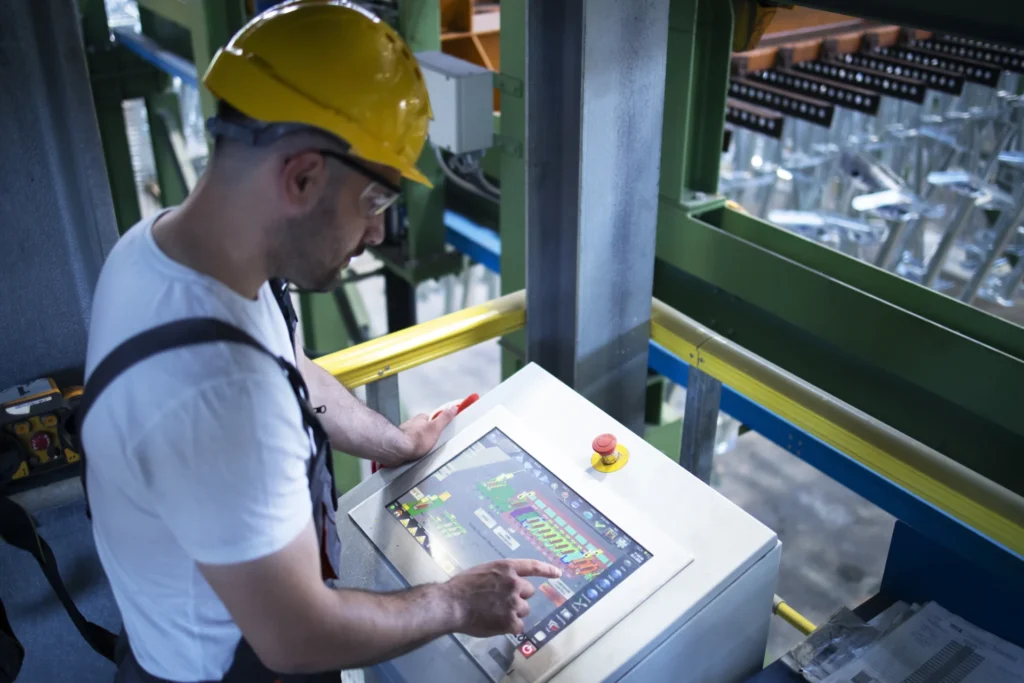
A PLC may record equipment operating parameters, SCADA may store trends and alarms, MES can link production data to an order, operation, product, or downtime reason, and ERP adds further business context. Some information may still be entered manually by operators.
Only by combining these data sources can you determine what actually happened during the manufacturing process.
If a model is expected to identify relationships between process parameters and product quality, temperature history must be linkable to the quality result and the corresponding process run.
The same applies to downtime analysis. A machine status can tell you that equipment was not running, but it does not explain why. In many industrial applications of AI, the value of data depends on whether it can be connected to process context and the outcome you want to analyze.
This does not mean you need to integrate your entire enterprise before starting. If your first project concerns one production line, begin with the data sources required for that specific area.
The explitia team works at this layer. We collect data from machines and sensors, integrate it with manufacturing systems, and implement MES environments. We also offer a pre-implementation audit as a stage during which we assess data sources, systems, and the actual process flow before the main implementation begins.
For an AI project, this type of analysis can help you determine whether the data required to solve the problem actually exists and whether it can be connected reliably.
Prepare Your Data for AI by Digitizing Your Machine Park.
Data security requires specific answers
Manufacturing data can reveal how a product is made, process settings, recipes, equipment parameters, quality issues, and failure history. Some of this information may have significant technological or business value to the company.
Before sending data to an AI system, determine:
- Where will the data be processed and stored?
- Who will have access to it?
- Can the provider use submitted data or generated outputs to further train its models?
- How are data retention and deletion handled?
There is no single architecture that is right for every project. Some solutions can run in the cloud, while others may operate within infrastructure controlled by the company or locally, without public internet access. The choice should depend on the nature of the data, how the system will be used, and the associated risk assessment.
The NIST AI Risk Management Framework organizes AI risk management around four functions: Govern, Map, Measure, and Manage. The framework also includes post-deployment monitoring because changes in data or operating conditions can affect how a system behaves.
In a manufacturing environment, changes in raw materials, recipes, line parameters, or the way events are recorded may cause current data to differ from the data on which the model was originally evaluated.
An AI use policy should come before broad adoption
If employees start using generative AI tools independently, prompt training alone will not solve the problem.
At a minimum, your facility should consider defining:
- which tools employees are allowed to use,
- what types of data may be entered into those tools,
- who approves new AI use cases,
- when an AI-generated result requires additional human review,
- who employees should contact if they have concerns about security or system accuracy.
The importance of employee capabilities is also reflected in the EU AI Act. Article 4, applicable since February 2, 2025, requires providers and deployers of AI systems to take measures that support an appropriate level of AI literacy among people using AI systems on their behalf. These measures should take into account employees’ knowledge, experience, and the context in which AI is used. Supervision and enforcement of Article 4 by national market surveillance authorities began on August 2, 2026.
For someone responsible for manufacturing, this means employees should understand how to use the tool, when its output needs to be verified, and what data they are allowed to submit.
Prepare just one use case
Your first AI project can be intentionally small. It may focus on an area where the problem occurs regularly, its impact can be measured, the required data is already available or can reasonably be collected, and the scope can be limited to a single machine, line, or part of the process.
Consider a hypothetical example in which a group of machines is responsible for recurring unplanned stops. The company has a history of operating parameters and has reliably recorded the causes of at least some failures.
The first objective does not need to be predictive maintenance across the entire facility. Instead, you can test whether the data contains signals associated with a specific group of failures and whether those signals can be detected early enough to support action.
Before running the model, you also need to define how the project will be evaluated. In this case, relevant measures could include the number of correctly detected events, the number of false alarms, and the amount of time the team has to respond. A good pilot reduces uncertainty before a larger investment.
This approach is also consistent with implementation practices for manufacturing systems: first identify needs and conduct an audit, then run a pilot, and only proceed with a full-scale implementation after the direction has been validated.
Stop the project before making a larger investment if:
- you cannot identify the KPI that is expected to change,
- it is unclear where the required data will come from,
- the most important events do not have reliably recorded causes,
- you cannot define rules for sharing or processing data,
- no one on the business side is accountable for the outcome,
- project success is defined only as successfully launching a model.
This type of assessment can often identify a project that is not yet ready for a pilot.
Who should be responsible for an AI in manufacturing project?
An AI project for manufacturing should not be left entirely to the IT team. IT can take care of infrastructure, integrations, and security, but manufacturing teams understand whether the model output actually solves an operational problem.
A production director or COO should therefore ensure that the process owner is involved. The project also requires people who understand data sources, automation, and systems architecture. Depending on the use case, security, legal, or compliance teams may also need to participate in the evaluation.
The division of responsibilities should remain simple:
- Manufacturing defines the problem and the expected outcome.
- Process experts and automation engineers explain what the data means.
- IT is responsible for how the data is collected, integrated, and secured.
- The solution provider should explain how the system works, how performance is measured, and what limitations the solution has.
If a conversation with a provider begins with the name of an AI model rather than with your process and data, that is a sign that the discussion is starting in the wrong place.

How can you assess whether your company is ready for its first AI implementation?
Before approving a pilot, make sure you know the answers to the following questions:
- What problem should the system solve?
- How do we currently measure the scale of that problem?
- Which KPI should improve?
- What data do we need?
- Can we connect the data to the process outcome?
- Where will the information be processed, and who will have access to it?
- Who is accountable for the result on the business side?
- What outcome would justify expanding the project?
Not every answer has to be obvious from the beginning. However, if most of these questions still require investigation, your first project should probably be an audit of the process and data rather than the purchase of an AI solution.
This stage may include an analysis of manufacturing processes, data sources, IT/OT infrastructure, and integrations with machines and MES systems. Implementation can also be carried out in phases, with an audit and pilot project before broader deployment.
This is the right time to talk with a technology team and determine whether the problem is a good candidate for an AI project and what is still missing before the project can begin.
Your first AI decision should be about the process
You do not need to achieve full data maturity before starting your first AI project. You do, however, need to understand the problem, the information required to analyze it, and the rules governing the use of technology in that specific area well enough to make a responsible decision.
Before discussing models, bring together the process owner, IT or automation specialists, and the people responsible for data. Choose one problem and evaluate it using VALUE × DATA × CONTROL.
If the project does not pass that assessment, improve the foundations first. If it does, you have a justified starting point for a pilot.
The AI in manufacturing future will not be determined by how many models a factory deploys, but by whether artificial intelligence in manufacturing produces measurable operational improvements. The same principle applies to smart manufacturing more broadly: technology should improve a specific process, and the company should be able to measure that change.
A successful implementation of AI in industry can ultimately be evaluated using a simple criterion: a specific process should perform better than it did before, and the company must be able to prove it.

FAQ
How much data is needed to implement AI in manufacturing?
There is no universal number of records required. The amount of data depends on the type of problem, process variability, the frequency of the events being analyzed, data quality, and the methodology being used.
A large volume of poorly labeled data may be less useful than a smaller dataset that includes reliable process context.
Does AI in manufacturing require an MES system?
No. Data can come directly from machines, PLCs, SCADA, ERP systems, databases, or other sources. However, an MES can provide context related to production orders, products, operations, quality, and downtime that is necessary for many manufacturing analyses.
MES systems implemented by explitia connect data from the shop floor, machines, and other systems and make it possible to analyze that information in the context of the manufacturing process.
Can an AI model operate without internet access?
Yes, depending on the technology being used. Models can operate locally or within infrastructure controlled by the company.
The architecture should be selected based on technical requirements and the risks associated with the information being processed.
Where should you start with AI in manufacturing?
Start with one measurable problem. Then assess data availability, the meaning of that data within the process, security requirements, and the KPI you want to improve. Only after completing this evaluation can you make an informed decision about the technology and the scope of the pilot.
We’ll Help You Determine Where AI Can Deliver Value in Your Facility
Read the Latest Blog Posts and Discover More Ways to Improve Manufacturing