

IT system implementation schedule – why projects don’t derail suddenly
An IT system implementation schedule. It usually appears in a project as a PDF file or a Gantt chart that someone opens at the kick-off and then… comes back to only when delays start piling up.
The truth is that when someone says an IT project “suddenly got delayed”, there’s a high probability it had been slipping for a long time. Only no one saw it – or no one wanted to see it. Meanwhile, a schedule can help you understand what’s happening with the project before it’s too late.
This article shows how to approach an IT system implementation schedule in practice – without idealizing it, but also without chaos.
An IT system implementation schedule is not a task list
Let’s start with the basics, because this is where conceptual confusion very often appears. Let’s put it as an anti-definition: a schedule is not:
- a backlog,
- a developers’ work plan,
- a list of tickets in JIRA.
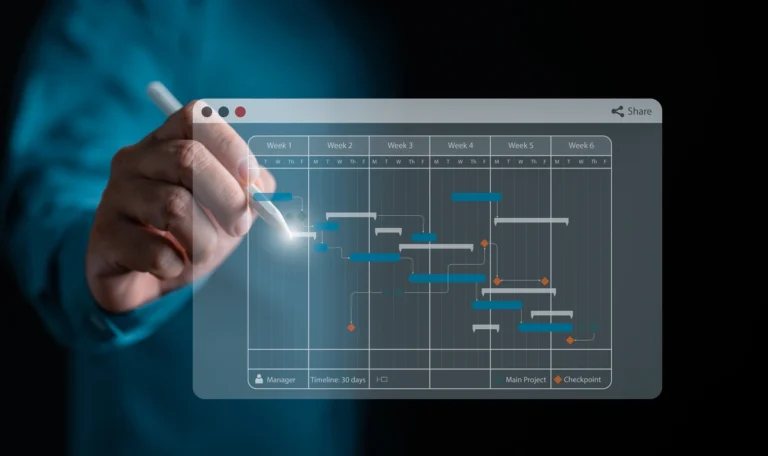
An IT implementation schedule is – speaking figuratively – a story of the project framed within a timeline. In other words, it’s a map that doesn’t show everything developers or automation engineers do, but it does show successive stages, their order, dependencies, and checkpoints. All of this makes it possible to verify whether we’re still heading in the right direction.
An IT system implementation schedule is written to be readable for the client as well. The client doesn’t need to know that someone is creating a control element or writing a script. The client wants to know when they will:
- see a working module,
- be able to test the solution,
- have the system actually start running in production.
So when implementing IT systems, the schedule should describe outcomes, not technical execution details.

What’s the point of the whole schedule?
The answer to the above question is short. Without an IT system implementation schedule, the project quickly starts to look like executing a plan called “we’ll somehow manage”.
A schedule, especially in IT implementations:
- organizes shared expectations,
- defines areas of responsibility,
- provides a reference point for discussions about changes,
- makes it possible to spot early that something is drifting off track.
Importantly, these functions of an IT system implementation schedule in an organization matter for both sides: the client and the IT company. The schedule is not a tool for the client to control the provider, nor the other way around. It’s more like a map that helps both parties know where they are and where they’re going.

If you’re planning an IT implementation in a production environment and want to see what a real schedule looks like, let’s talk
Free 360 workshop or a pre-implementation audit is the fastest way to avoid “unexpected” delays.
IT system implementation scheduling under the microscope – stages of an IT implementation
In theory, everything can be planned perfectly. Sure, every project is a bit different, but certain stages repeat – though with different weight and often in a different order.
Pre-implementation analysis and workshops
Before a meaningful schedule is created, you need to know what is actually going to be implemented. That’s exactly what the pre-implementation analysis and workshops are for. It’s one of the most important stages of implementing an IT system in an organization, because this is where decisions are made that later affect the entire schedule. Without it, the schedule is a guessing game. This is the stage where it turns out that:
- machine data is not ready after all,
- integration with the ERP system isn’t that straightforward,
- some “on-paper” assumptions don’t translate into real plant conditions.
A good schedule starts with a conversation, not with a tool, because only communication makes it possible to define:
- business goals,
- technical constraints,
- potential risks.
Design – not the best time to save time
Solution design is the stage where the system architecture is laid out: functional scope, integrations, data flow approach. A well-designed system shortens the next phases of the project; a poorly designed one will come back to bite you during testing or at Go-Live.
Development and configuration – theory meets reality
This is the stage everyone associates with “building the system”. In the schedule, it’s worth treating it iteratively, because it’s rare that everything can be predicted upfront. It’s important that the schedule leaves room for adjustments here instead of assuming a perfect run.
Integrations – the most common source of slippage
Integrations with other systems are a classic flashpoint in projects. Waiting for data, machines, PLCs, servers, or subcontractors is everyday reality. In practice, implementing IT systems in a production environment very rarely happens in isolation from other tools. A schedule that doesn’t account for that is wishful thinking. An IT system implementation schedule that includes buffers – gives room to maneuver.
Testing – don’t skip this stage
Testing is not a reward at the end of the project. It’s part of it and should have its place in the schedule – together with time for fixes and stabilization. No testing in the schedule is the shortest road to problems after launch.
Training and Go-Live
The system may be ready, and the project can still fail if users don’t know how to use it. The schedule should include training, materials, and time to “get comfortable” with the new solution.

How long does an IT implementation take?
Alright – if implementation scheduling includes so many stages, how much time can it actually take? It depends. And any other answer would be dishonest.
Implementation time depends on the project scope, the number of integrations, organizational readiness, and the real level of involvement on the client side. That’s why the first schedules are purely indicative. Only after the pre-implementation analysis do they take on concrete shapes.
Why do IT system implementation schedules break?
In IT implementations, schedules don’t break because someone miscalculated the number of days needed for implementation, but because the realities of how the organization works were not taken into account.
The most common scheduling mistakes are:
- no time buffers,
- overly optimistic assumptions,
- underestimating the involvement required from one of the sides,
- poorly selected or poorly defined milestones.
A schedule without a buffer isn’t a plan. It’s a fantasy.

Scheduling in industrial projects – a different league
In projects delivered by explitia, the schedule must account for production realities. We know perfectly well that an IT system does not operate separately from the plant – it runs on the shop floor, with people, existing software, and machinery. On top of that come variables such as production continuity, safety, and IT/OT integration.
In short, in industrial projects, implementing an IT system in an organization means working on a living organism – not in a test environment.
The schedule doesn’t promise miracles
A good IT implementation schedule is not a promise that everything will definitely work out. It’s more like support from a colleague who says: “We know what we’re doing, we know where the risks are, and we know what we’ll do when something changes”.
And that’s perfectly enough for the project to make sense.
Looking for IT systems for your manufacturing company? Want to digitalize production? Book a free consultation!
Gain knowledge to stay ahead of the competition! Read the explitia blog