


Calculate takt time and align production with demand
Takt time shows how often a finished product should come off the line so that production can keep up with customer orders. By comparing it to the actual cycle time, you can determine whether the line will meet its target, which workstation is limiting its throughput, and where work-in-progress is beginning to build up.
Below you’ll find a formula, a sample calculation, and a simple explanation of the result. You’ll also see when a shorter cycle time is helpful and when it leads to overproduction.
What is takt time?
Takt time determines the production pace based on customer demand.
If customers need 240 units per day and the plant has 480 minutes of available time, the next product should come off the line every 2 minutes.
The Lean Enterprise Institute defines takt time as available production time divided by customer demand. The purpose of this metric is to synchronize the pace of the process with the number of products needed by customers.
However, the cycle time does not indicate the machine’s maximum speed; rather, it helps determine how often a good unit must be produced in order for the plant to meet its production plan within the available time.
A good piece is a product that meets the requirements. Defective items and products designated for rework do not count toward the order, even if they are included in the production report.
A properly set cycle helps you minimize two costly issues:
- backlogs leading to overtime and delays,
- producing faster than demand requires, which leads to an increase in inventory and the number of work-in-progress items between operations.
How do you calculate takt time?
The formula is simple:
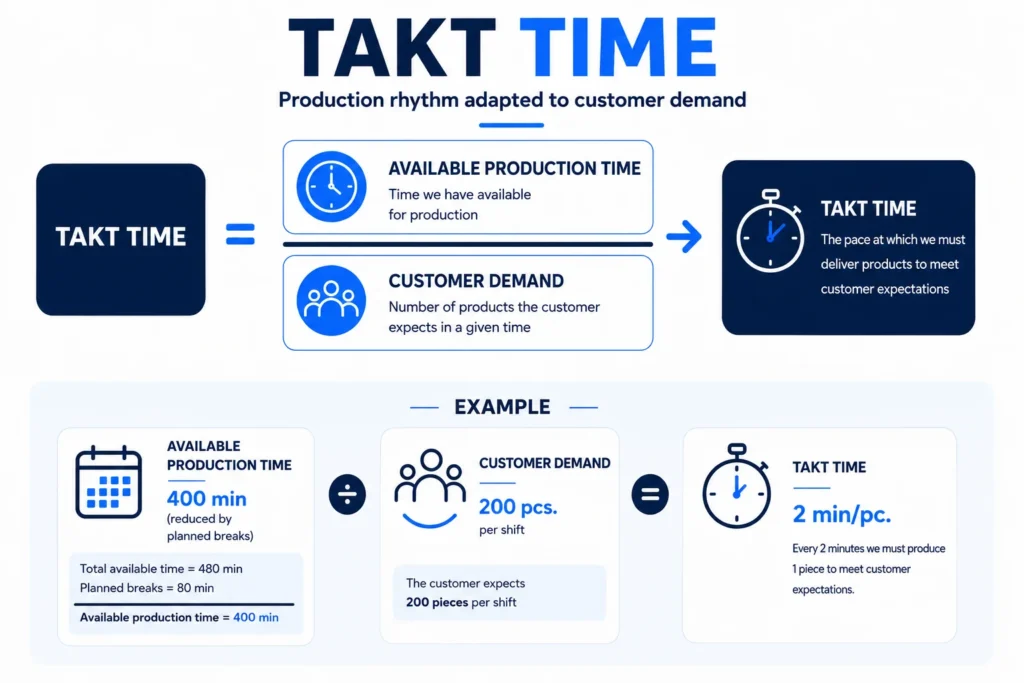
The result is usually given in seconds or minutes per unit.
Both values must refer to the same period. When calculating the available time for a single shift, use the demand for that shift, but do not combine daily time with weekly demand.
What counts as available time?
Subtract the scheduled non-production periods from the shift duration; for example:
- breaks,
- briefings,
- scheduled cleaning,
- organizational tasks,
- scheduled maintenance.
When determining the customer’s takt time, do not subtract downtime and other unplanned losses from the total time. It reflects the pace required by demand. Analyze downtime separately, as it determines whether the process has the actual capacity to maintain the specified cycle time.
Separation can protect you from a situation where poor line availability is hidden within the formula itself.
Example of a Takt Time Calculation
Let’s say you’re in charge of a production line that manufactures assembly components.
Data for a single shift:
- shift length: 8 hours, or 480 minutes,
- two 15-minute breaks,
- lunch break: 30 minutes,
- briefing and setup: 20 minutes,
- Requirement: 200 good-quality items.
First, calculate the time available:
480 – 30 – 30 – 20 = 400 minutes
Next, divide the result by the required 200 units:
400 minutes / 200 pieces = 2 minutes per piece
The cycle time is:
2 minutes, or 120 seconds each
The line should therefore produce another good product every 120 seconds on average.
However, this still does not confirm that the plan will be carried out, because the actual working time at each workstation must be measured and compared with the calculated cycle time.
Cycle time vs. takt time: How do these metrics differ?
Takt time defines the required production rate, while cycle time shows the actual rate.
Cycle time is the time required to complete a piece, an operation, or a full process cycle; therefore, it should be based on measurements taken during normal operation.
| Index | What does it show? | Data source |
| Takt time | How often should good art be created? | Available Time and Demand |
| Cycle time | How long does a procedure or surgery actually take? | Process Measurement |
| Lead time | How long does it take for a product or order to go through the entire process? | Work, waiting, lines, and transportation |
Let’s go back to the example where the beat is 120 seconds.
If the station’s cycle time is 105 seconds, the operation has a 15-second buffer relative to the required pace.
When the cycle lasts 135 seconds, the workstation can’t keep up.
Within an hour:
- A 120-second cycle requires the production of 30 units,
- A 135-second cycle allows for the production of approximately 26.7 units,
- The shortfall exceeds 3 units per hour.
After eight hours, the difference can exceed 26 units. A difference of just a dozen or so seconds above the target rate quickly turns into a noticeable backlog by the end of the shift.
How should cycle time be interpreted in relation to the takt?
Comparing the two values leads to different decisions. Simply stating that the result is good or bad won’t give you enough information.
Cycle time is longer than takt time
This indicates that the process does not have sufficient capacity to consistently meet demand.
Check it out:
- which task takes the most time,
- where the operator waits for the material or the machine,
- Are the tasks distributed evenly among the positions,
- How much time do revisions take,
- How often do micro-downtimes extend the cycle,
- Do retooling efforts limit the availability of the process?
Adding a worker will not always shorten the cycle time. If the bottleneck is caused by the machine’s automated operation, a shortage of components, or frequent stoppages, increasing the number of workers may not improve the outcome.
First, break the cycle down into individual steps; only then should you decide whether changes are needed to the workstation layout, process parameters, task allocation, or the number of operators.
Cycle time is similar to takt time
The line is operating close to the required pace, but has little margin for disruptions.
An average cycle time of 118 seconds may look good with a 120-second takt time, but if subsequent measurements fall within the range of 95 to 145 seconds, the process remains unstable.
In that case, the average masks frequent deviations.
Don’t base your assessment on a single sample; instead, measure a series of consecutive cycles and check:
- How many measurements exceeded the cycle,
- How big is the difference between the shortest and longest cycles,
- which activities are responsible for the deviations.
Cycle time is significantly shorter than takt time
The process has a higher capacity than current demand requires.
Continuous operation at maximum speed can increase finished goods inventory and work-in-progress. In a Lean system, the takt time works in conjunction with the flow and pull system. Subsequent products should be produced according to demand, without creating excess inventory simply because the machine is capable of operating faster.
The available time can be allocated to other orders, maintenance, quality control, or staff changes. Production for inventory should be based on the schedule, not solely on equipment availability.
See how the Production Portal can help you achieve an optimal takt time.
How does takt time support Lean Manufacturing?
In lean manufacturing, takt time translates order quantities into the work rhythm of workstations. This allows the production manager to assess:
- Is the current cast enough,
- which position exceeds the required time,
- how to divide tasks among operators,
- Does the line maintain too large a buffer,
- where the cycle needs to be shortened,
- Does a change in demand call for a new plan?
Takt time is also one of the elements of standardized work. The others are a fixed sequence of tasks and the minimum inventory needed to maintain the process.
The takt time can also help in an initial estimate of the number of operators needed. If the total manual work required to produce one unit is 420 seconds, and the takt time is 120 seconds:
420 / 120 = 3.5
The preliminary result indicates that four operators will be needed. This calculation is no substitute for balancing the line. You should also take into account the sequence of operations, machine operating times, ergonomics, the possibility of combining tasks, and cycle variability. However, it can provide you with a solid foundation for discussing staffing.
Errors That Cause the Takt Time to Lose Its Value
Counting the beat over the full length of the measure
Eight hours on the schedule do not usually equate to eight hours of production, so scheduled breaks and non-production activities should be subtracted.
Using machine capacity instead of demand
The machine’s maximum speed does not determine the production rate. The starting point should be the number of good units required by the customer.
Treating the result as a constant value
The pace changes depending on demand and available time. It should be recalculated whenever there is a change in the number of orders, the shift schedule, or the work calendar.
Comparing Different Units
Do not directly compare seconds per piece with pieces per hour. First, convert both results to the same unit.
Evaluating the process based on the average
An average of 118 seconds does not indicate how many cycles exceeded the 120-second mark. When planning, what matters is consistency, not the best recorded result.
One beat for very different products
In a production environment with high variability, a single result for the entire plant can lead to incorrect decisions.
It is a good idea to group products based on similar production processes, technology families, or labor content. Production runs are also applicable to small batches, but require a sensible division of the product range and demand.
How do you start using takt time?
Choose a single product line or product family and set a short, clear timeframe for it—for example, one shift.
- Specify the demand for the selected period.
- Calculate the available time for the same period.
- Calculate the cycle time in seconds or minutes per unit.
- Measure a series of actual cycles at each test station.
- Select the operations that regularly exceed the cycle time.
- Break down their time by activity and identify the source of the delay.
Base your first decision on the station that most often exceeds the required cycle time. Then determine whether the cycle time is extended by manual work, waiting, machine downtime, rework, or material delivery.
A spreadsheet is sufficient for initial measurements. When a company wants to track cycle times, downtime, and plan fulfillment across multiple workstations, it’s worth exploring the capabilities of an MES system.
The cycle time is intended to guide decision-making during the changeover, not to result in yet another number recorded in the report. Demand determines the required quantity, available time sets the pace, and cycle time shows whether the process can keep up.

FAQ
Do “tact time” and “cycle time” mean the same thing?
No. Takt time is based on customer demand, while cycle time reflects the actual time it takes to produce a product or complete an operation.
Should cycle time be shorter than takt time?
Yes. The process needs a reasonable margin to account for variability and minor disruptions. However, a very large difference can lead to overproduction if the line is constantly running at maximum speed.
Are outages deducted from the available time?
When determining the customer’s cycle time, subtract any planned downtime. Analyze breakdowns and other unplanned losses separately, as they affect the process’s actual capacity.
How often should you recalculate the cycle time?
After changes in demand, available time, the number of shifts, or the production schedule. For fluctuating orders, set a regular update schedule.
Does takt time work well in small-batch production?
Yes, although it often needs to be calculated for a product family, a common stream, or a comparable unit of work.
Is an ERP system required to calculate takt time?
No. The initial calculation can be done in a spreadsheet. MES is useful when a company wants to automatically collect cycle times, downtime, and data on plan fulfillment.
Need help calculating and optimizing takt time? We’re here for you.
Explore the articles on the explitia blog and get inspired to improve your production.