

The MES system reduced changeover planning time at a foam manufacturer and integrated data from four production lines
The MES system helped the client reduce manual planning in spreadsheets and align the schedule with the actual production status. It allows the planner to prepare several versions of the plan, assess line capacity, and send the selected option directly to production.
- Industry: automotive components manufacturing
- Scope: four automotive foam production lines
- Solution: Production Portal-class MES system, changeover planning, production execution, OEE, quality reports, and SPC
- Goal: Faster planning, fewer manual tasks, and better use of available resources
Manual planning prolonged production preparation
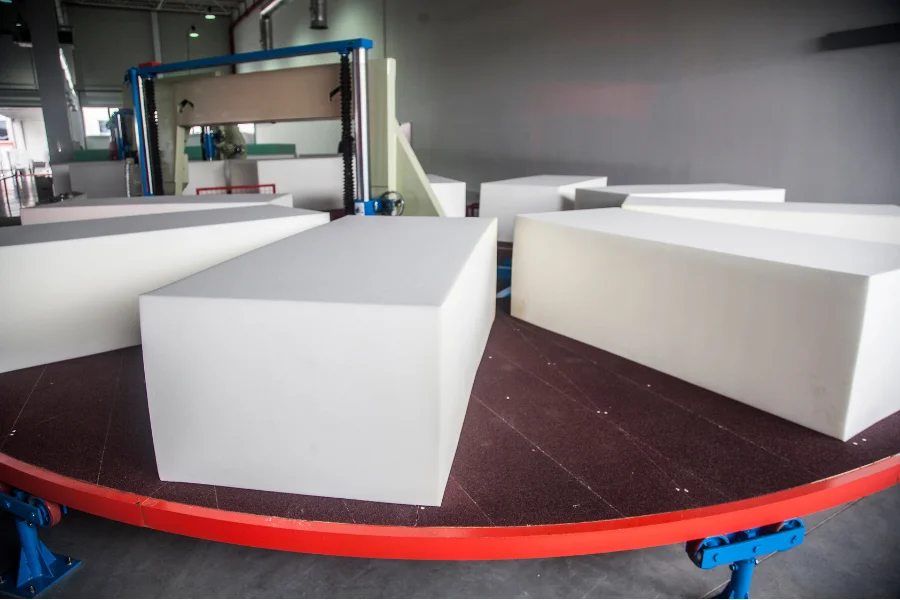
The client manufactures foam for car seats, sofas, and headrests. Different products require different molds, carts, and line configurations, so every product change affects the production sequence and the scope of changeovers.
Previously, the plan was created mainly in Excel. The planner manually checked tool availability, created the schedule, and forwarded the files to production and the maintenance department.
This workflow increased the number of manual tasks and made it difficult to update the schedule efficiently. There was also a lack of real-time information from the production line that would allow for monitoring schedule adherence and analyzing downtime, waste, and productivity.
With a large number of products and frequent changeovers, the spreadsheet was no longer providing planners with the control they needed.
There are several versions of the plan, but only one goes into production
One of the key elements of the implementation is the Plan Stashes mechanism, which serves as a repository for alternative versions of the production plan.
A planner can prepare a complete schedule for a selected line, save it without running it, and move on to working on the next variant. The system estimates the production capacity of individual scenarios, ensuring that the decision takes current constraints into account.
The clipboard might contain, for example, a plan that calls for an earlier mold change or an alternative plan prepared in case a cart is unavailable. Ultimately, only the version selected by the planner is implemented.
Saved scenarios can be executed later. If the order sequence or the situation on the production line changes, there is no need to rebuild the entire plan from scratch.

The MES system takes into account the status of molds, carts, and production lines
The system covers production planning and changeovers on four production lines. The schedule is prepared using a Gantt chart, and recurring operations can be organized using templates.
The plan takes into account the unavailability of production lines, molds, and carts, and also identifies various types of work, such as product changeovers or the replacement of a mold, a cart, or an entire assembly.
Two-way integration with the production line control system links planning with execution. Among other things, the MES records mold movements, foam dispensing, process parameters, and downtime. It also transmits production tasks to the production line for execution.
In this way, the planner, production, and maintenance teams can access up-to-date information available in a single system.
The various forms required an accurate representation of the process
The mold used in the production of the headrest differs in size and specifications from the tool required to manufacture the rear seat. These differences affect the method of transport, the sequence of operations, and the possible layout of the production line.
The system therefore had to take into account the parameters of specific molds and carts, rather than treating every changeover according to a single template.
The process logic has been broken down into individual events, such as removing a mold, changing the cart, loading a new set, or switching products. Templates speed up the creation of repetitive sequences, and the line status preview helps verify the feasibility of the schedule before it is approved.
Another area was ensuring that the data matched the actual production status. The information is retrieved from the production line’s automation system, and in the event of a failure, the user can manually correct the recorded status.
We launched the system sequentially on each line
The project began with workshops with planners. The team analyzed the changeover process, technical constraints, and the current method of preparing schedules.
The rollout took place in phases, and after implementation and testing on the first line, the team moved on to the next one. Each phase included user training and handling of issues related to day-to-day operations.
The system also retained a spreadsheet-like interface, which made it easier for planners to transition to the new tool without having to give up the layout they were already familiar with.
What Has Changed Since the Implementation of the MES?
- Planning changeovers takes less time. The system has reduced the number of tasks that were previously performed manually and has sped up the preparation of subsequent stages of the schedule.
- A planner can explore several scenarios. Alternative versions remain in the clipboard until one of them is selected for implementation.
- Production data is being sent back to the system. MES displays task completion, downtime, process parameters, and waste.
- The plan is not shared among teams as a file. Production, maintenance, and planning all use the same set of information.
- It’s easier to analyze performance and quality. The system provides OEE, shift summaries, NOK root cause reports, a defect heat map, and SPC analyses.
The most noticeable result is a reduction in the time needed to plan subsequent stages and a decrease in manual operations.

Which industries and facilities stand to benefit the most from this solution?
Changeover planning in MES is well-suited for production involving a large number of variants or frequent changes of molds, tools, or equipment. This approach can also be used in implementations across most industries, including MES systems for the tobacco or food industries, provided that similar constraints exist in the process.
A facility where the scheduler manually checks various constraints each time—and where production performance data is not fed back into the schedule—stands to gain the most. Data on production performance, downtime, productivity, and quality can also support OEE analysis, for example, in the cosmetics industry.
The planning module in the MES system and the explitia Production Portal can integrate the schedule, machine data, and performance analysis, taking into account the specific characteristics of a given production line.
To start things off, a workshop with the planner and the production manager
If you think this solution would also work well in your production, the best first step is to review your current planning process. We can help you with this during a free workshop, where our team will assist you in analyzing:
- machines, production lines, molds, and carts,
- frequency of product changes,
- data available in the machine control system,
- operations that are still performed manually.
Based on this, it will be possible to determine the scope of integration, the necessary functions, and how to measure the results. The first meeting should be attended by the lead planner and the production manager responsible for changeovers.
Contact the explitia team to find out how an MES system can support changeover planning based on data from your production lines.
Discover how the Production Portal can improve your manufacturing plant.
Read the latest blog posts and expand your knowledge of technology in manufacturing.