

ERP vs. MES Systems: How to Manage Production Optimally
TERP vs MES: Which System Supports Manufacturing Better and When Should You Combine Both?
If you run a manufacturing company, sooner or later you will face the question: ERP vs MES. Some companies look at it the other way around and ask MES vs ERP. Both questions matter, because both systems can improve how production works.
The problem is that the names sound familiar, but the difference between them is not always clear. As a result, one company buys a system that is too broad for the problem it wants to solve, while another chooses a tool that works well on the shop floor but does not organize the wider business. That often leads to delays, manual work, inconsistent data, and frustration across teams.
This article gives you the full picture: the difference between ERP and MES, where a MES system makes sense, when an ERP system is enough, and when ERP and MES integration is the better option. You will also see why many manufacturers get the best results when both systems work together.
ERP vs MES: a simple comparison
The easiest way to explain it is this:
That means ERP has a broad scope. It usually covers sales, purchasing, inventory, finance, HR, planning, and reporting. MES goes deep into production itself. It tracks work orders, collects real-time data, supports quality control, shows downtime, and helps manage production processes on the shop floor.
So when we compare ERP vs MES, the real question is not which system is better. The real question is which one, or which combination of both, fits your current needs.

Let's help you answer the ERP vs MES dilemma
Chosing the most optimal solution for your production management can be difficult. Send us a message and we’ll help you decide wether you should choose MES, ERP or both.
What is ERP?
ERP stands for Enterprise Resource Planning. It is a system used to manage company resources and business operations across the organization. It connects data from different departments and puts business processes in one place.
An ERP system usually includes:
- finance and accounting
- purchasing
- inventory management
- warehouse and logistics
- sales management
- customer relationship management
- HR and time tracking
- production planning
- supply chain management
So an ERP system covers the whole company, not just production. That is why it gives different teams one shared view of what is happening.
What does ERP do?
ERP systems help improve cost control, keep data organized, and make information flow better between departments. Good ERP software also reduces manual data entry and supports better planning for orders, deliveries, and production.
If your company still works across spreadsheets, separate tools, and emails, ERP implementation is often the first step toward a more organized operation.
What is MES?
MES stands for Manufacturing Execution System. Its role is to support what happens directly on the shop floor. If ERP plans and settles, MES watches execution.
A MES system focuses on production operations, not the whole business. That is one of the main differences between MES and ERP.
MES usually covers areas such as:
- production execution
- detailed operation scheduling
- production monitoring
- data collection from machines and workstations
- quality control
- batch and material traceability
- work order management
- downtime analysis
- equipment performance tracking
- KPIs such as OEE
In manufacturing, a MES system works at a very detailed level. It shows what is actually happening on the shop floor, not only what was planned.
What does a MES system do?
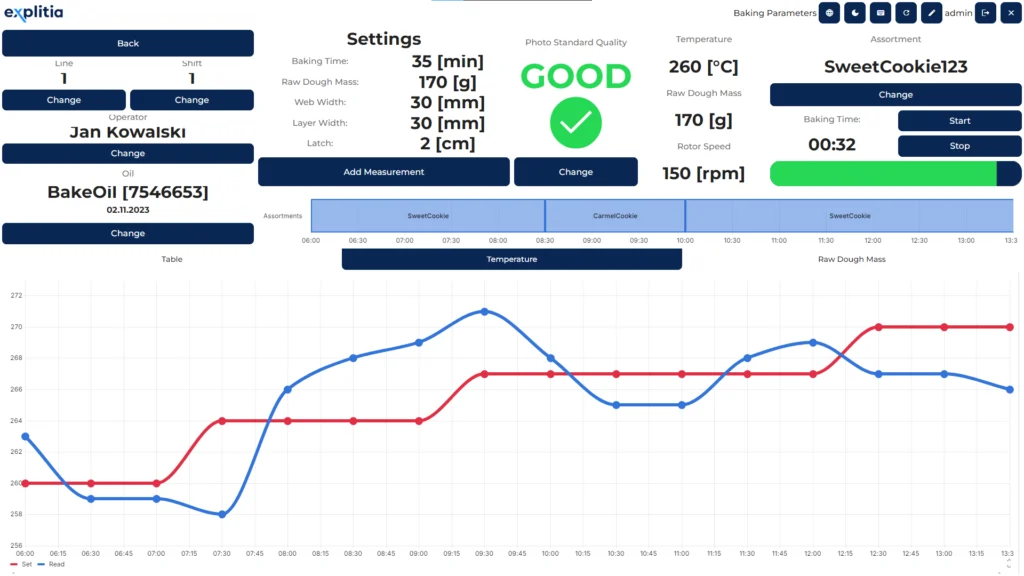
The biggest benefit is access to real-time production data. That means a production manager does not need to wait until the end of the shift or the next day to see problems. They can react while something is happening. This helps with production management, quality, loss tracking, and performance improvement.
ERP vs MES: key differences
| Area | ERP | MES |
|---|---|---|
| Main role | Manage the whole business | Manage production execution |
| Scope | Sales, purchasing, warehouse, finance, HR, planning | Production, quality, downtime, performance, operations |
| Data level | Business and planning data | Operational and detailed data |
| Response time | Days, weeks, months | Minutes, hours, shifts |
| Main users | Management, sales, logistics, purchasing, finance | Production managers, supervisors, engineers, quality teams |
| Type of data | Orders, costs, inventory, documents | Real-time data, machine data, operation status |
| Production role | Production planning | Manufacturing execution |
| Quality | Reporting and settlement | Ongoing quality control |
| Goal | Manage company resources | Control execution and improve production processes |
This comparison shows why the MES vs ERP question can be misleading. Both systems matter, but they work at different levels.
How does the difference look in day-to-day work?
Let’s say a customer places an order for a specific product.
ERP receives the order, starts planning, checks inventory levels, delivery dates, costs, and required resources. It supports resource planning and connects production with purchasing, logistics, and finance.
Then the MES system takes over its part. It breaks the order into operations, machines, workstations, and people. It records start and end times, downtime, scrap, and material usage. It also supports production monitoring and quality control.
So in practice:
- ERP shows what needs to be done and how it should be planned and settled
- MES shows how the work was actually carried out
- both systems exchange data
This is where cooperation between ERP and production systems starts to matter.
Where does ERP work best?
ERP is the better choice when your company needs to organize the whole business, not just the shop floor.
ERP implementation is worth considering when:
- data is spread across different tools
- there is no single source of truth for orders and costs
- inventory records contain errors
- purchasing, sales, and warehousing are poorly connected
- it is hard to measure order profitability
- supply chain management needs improvement
- the company wants to connect production with finance and logistics
In that case, ERP software brings more order, more predictability, and fewer daily headaches.
Where does MES work best?
A MES system is worth implementing when the biggest problems are not in documents or finance, but in production itself.
MES is a good fit when:
- shop floor reporting is manual and delayed
- the source of downtime is unclear
- machine performance is hard to measure
- quality is unstable
- full batch traceability is required
- fast reaction to production events matters
- real-time data is needed
In those conditions, the capabilities of a manufacturing execution system usually go much further than a standard production module inside ERP.
Similarities between ERP and MES
People usually focus on the differences, but ERP and MES also have a lot in common. Both systems:
- support production management
- organize data
- help with planning and control
- reduce errors
- support process improvement
- make decision-making easier through data
The difference is that ERP does this at the business level, while MES focuses on the execution of production operations.
When is ERP not enough?
Many companies assume that a well-developed ERP system will cover everything. Sometimes that works. But in more demanding production environments, the limits appear quickly.
ERP may not be enough when:
- you need machine data
- real-time production monitoring matters
- fast reaction to deviations is required
- you need to measure OEE
- detailed quality control is necessary
- paperless production is a goal
- production automation becomes more important
In those cases, ERP software is often too general on its own.
When is MES not enough?
A MES system does not replace the full business environment. If the company needs one place to manage sales, purchasing, finance, and warehousing, MES alone will not solve that.
This matters because some companies treat MES as a complete business management platform, and that is simply not its role.
Why combine ERP and MES?
This is where ERP and MES integration starts to make sense. When both systems work together, a company does not need to choose between a broad business view and detailed control of production.
What does ERP and MES integration look like?
In many cases it works like this:
- the customer places an order
- ERP plans resources, dates, and costs
- MES takes the order into execution
- production is carried out and monitored on the shop floor
- MES sends execution data back to ERP
- ERP updates costs, inventory, and order status
That is how both systems work together. One supports the business side, the other supports production execution. Together they create one consistent flow of data.
What are the benefits of ERP and MES integration?
- better delivery planning
- more accurate cost settlement
- better inventory management
- less manual reporting
- faster reaction to problems
- better resource management
- more predictable operations across the company
Well-planned MES and ERP integration also improves production processes and reduces errors caused by disconnected data.
ERP and MES integration with other systems
Manufacturing rarely runs on just MES and ERP. Most plants use other tools as well, so it helps to look at the wider environment.
That may include:
- WMS for warehouse management
- IoT solutions for collecting data from devices
- standards such as ISA-95 to organize the integration layer
- quality management and maintenance systems
If a company wants to connect ERP, MES, warehouse systems, and shop floor devices, it is important to define the role of each system clearly. Otherwise, instead of putting processes in order, the company creates another layer of confusion.

ERP vs MES in manufacturing companies
For manufacturers, the question about the difference between ERP and MES is really a question about process maturity and where the business is losing the most time or money today.
Start with ERP if:
- the problem affects the whole organization
- you want to connect sales, warehouse, finance, and production
- you need one source of data across the business
Start with MES if:
- the main problem is on the shop floor
- you need real-time production data
- you want better control over execution and quality
Implement ERP and MES together if:
- the company is ready for a bigger change
- you want to organize the whole data flow quickly
- you want the benefits of both systems from the start
Will any ERP or MES system do the job?
No. The fact that a product is labeled ERP or MES does not mean it fits your plant.
It is worth checking:
- whether the system supports your production model
- whether it makes production execution practical for daily use
- what MES features are actually included
- whether ERP, MES, and other tools can be integrated well
- whether the system supports paperless production
- whether it can collect machine data and calculate OEE
- whether it supports goals linked to Industry 4.0
There are many tools on the market, including industry-specific products. Some companies may look for a named solution such as explitia.MES, but the product name alone should not decide the choice. First, you need to review the plant’s processes, needs, and way of working.
ERP vs MES: what should you choose?
| When it makes sense to choose… | MES | ERP | ERP + MES |
|---|---|---|---|
| Real-time control of production is the top priority | Best choice | Does not fully cover this area | Very strong option |
| You want to monitor machines, operators, and production flow | Best choice | Limited capability | Very strong option |
| You want to reduce downtime and react faster to problems | Best choice | Not the main focus | Very strong option |
| Improving shop floor quality is the priority | Best choice | Supports this indirectly | Very strong option |
| You want to organize sales, purchasing, finance, and warehousing | Not the main focus | Best choice | Very strong option |
| You need better planning of resources, costs, and business processes | Limited use | Best choice | Very strong option |
| You want to connect business management with production execution | Not enough on its own | Not enough on its own | Best choice |
| You need full visibility from order to execution | Does not show the full business picture | Does not show shop floor detail | Best choice |
| You want more consistent data and better operational decisions | Good support for production | Good support for business | Best choice |
MES is usually the better choice when a company wants more control over production and better performance on the shop floor. ERP is the better option when the main goal is to organize business processes and manage the whole company. ERP and MES together make the most sense when you want better business control and full visibility into production execution at the same time.
FAQ
What is the difference between ERP and MES?
ERP manages company resources and business processes. MES manages production execution and monitors operations on the shop floor in real time.
Which should you choose: ERP or MES?
If the problem affects the whole company, ERP is usually the better starting point. If the biggest losses come from production itself, MES is often the better first step.
Does ERP and MES integration make sense?
Yes. ERP and MES integration creates one flow of data between business operations and production. It helps with planning, cost control, and faster reaction to problems.
Can MES work without ERP?
Yes, but it mainly covers production. A MES system does not replace sales, finance, purchasing, or full business planning.
Can ERP replace MES?
In simpler production environments, partly yes. But when real-time data, production monitoring, quality control, and performance analysis matter, ERP alone is usually not enough.
Leave us a message and we'll help you determine the next step for your production company
See how else can you optimise your production wit expliria blog