

AVEVA migration in automotive: how to use planned downtime to improve the entire system
In automotive manufacturing, every hour of downtime affects production. That is why an AVEVA migration cannot simply mean shutting down the old version, installing the new one, and checking whether everything works. In this project, we used the planned downtime more broadly: we not only moved the AVEVA environment to a newer version, but also cleaned up the data, optimized databases, and prepared the system for years of continued operation.
- Industry: automotive
- Goal: migration and standardization of the AVEVA environment
- Scope: MES, traceability, ERP integration, servers, and databases
- Challenge: a very limited production downtime window
- Additional work: data archiving and database optimization
- Result: easier maintenance, greater security, and improved system performance
The client was not starting from scratch
This project was another stage in our long-term cooperation. We had previously implemented solutions for the client including a traceability system, AVEVA-based process visualization, and solutions integrating production with the ERP system. This time, the goal was to move to a newer, proven version of the system and standardize the environment with the company’s other manufacturing plants.
This was important not only from an IT perspective. It was also about cybersecurity, easier maintenance, and continued access to vendor support. When several locations operate on similar system versions, updates become more predictable, troubleshooting is faster, and responding to potential vulnerabilities does not require a separate approach for every plant.
Start with a safe test environment
In a project like this, the worst-case scenario is discovering problems only during the actual production shutdown. To reduce the risk during the final cutover, we prepared the new environment in parallel with the live production system. We migrated the data and configuration and then performed tests using a test controller.
We verified the entire flow of information, from the machine through MES and traceability all the way to ERP posting. Only after this scenario worked correctly could we proceed with the actual cutover. The old system was not removed immediately. Instead, it remained available as a fallback in case we needed to return to the previous environment.
Make the most of production downtime
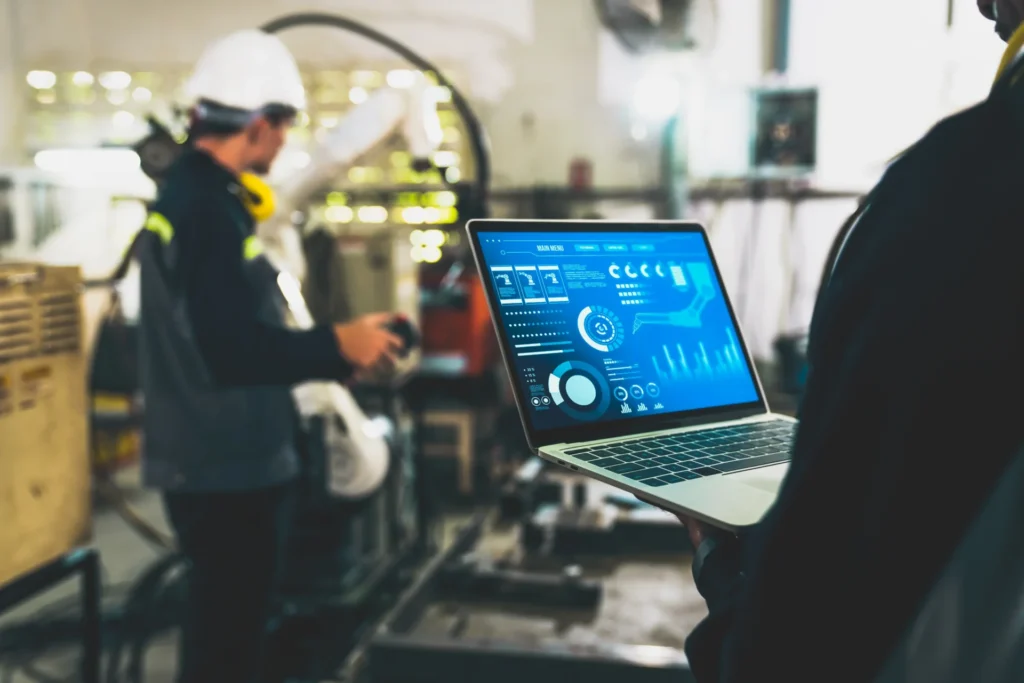
In automotive manufacturing, opportunities like this are limited. If the production line is already stopped, it makes sense to address other tasks that normally cannot be performed without affecting production. As part of the project, we therefore cleaned up the data, separated archival data, and carried out additional database optimization work.
These were not cosmetic improvements. During similar work performed previously for this client, we were able to reduce the MES response time for an individual part by approximately 40–50%. A version upgrade may be necessary, but the downtime itself becomes an opportunity to deal with issues that may otherwise remain on the backlog for months.
Most of the critical work happens during the cutover
When the actual shutdown began, we brought the new environment online gradually, machine by machine. First, we verified communication with the equipment. Then we checked ERP integration. Finally, operators performed real production tests on the machines. At the same time, we confirmed that data was being transferred correctly to both MES and ERP.
This approach makes it easier to identify the source of a problem. In an environment involving automation, networks, MES, traceability, ERP, and IT security controls, an issue does not always originate where its first symptoms appear. That is why good coordination between all teams on the client and integrator sides is just as important during the cutover as the technology itself.
The project does not end when production restarts
After all machines were brought back online, we maintained an increased level of support for another two weeks. This is when the system begins operating under normal production conditions and situations may arise that cannot be fully recreated during testing.
Sometimes the source of an issue is the application itself, the machine, the network, or a change introduced at the same time by another team. Fast diagnosis after go-live is therefore just as important as the cutover itself. It makes it possible to quickly distinguish migration-related issues from problems with other causes.
Migration is a good opportunity to clean up the environment
In a project like this, it is worth treating migration not only as a technical upgrade, but as one stage in the broader development of the entire production environment. If the decision to change versions is made only when the existing solution is approaching end of support, there may be much less time available for preparation, testing, and coordination. As a result, a project that could have been planned in a controlled way starts being carried out under pressure.
It is much better to prepare for the migration in advance and treat it as part of a broader system development roadmap. This gives you time to build a test environment, verify the complete data flow, prepare a rollback scenario, and coordinate activities between teams before the actual cutover begins. The more issues you can resolve beforehand, the fewer decisions you will need to make during commissioning itself.
In a production environment, every unexpected situation can affect the time required to return to normal operation. A well-planned migration helps reduce that risk while preparing the system for the years ahead, instead of reacting only when postponing the change is no longer an option.
Where does this approach work best?
Projects of this type are particularly important wherever production continuity, fast data flow, and full process traceability are critical. This includes automotive manufacturing, component production, machinery manufacturing, metalworking, and other high-volume manufacturing environments.
In these environments, an AVEVA system migration is often connected with broader requirements such as MES modernization, traceability implementation, MES-to-ERP integration, and stronger cybersecurity for production systems.
Planning a system migration or modernization?
If you are preparing an AVEVA migration, MES modernization, or integration between production systems and ERP, it is worth planning the project so that you not only reduce the risks associated with the cutover, but also make the best possible use of the maintenance window itself.
Plan your system migration with us.
Read the explitia blog and stay up to date with the latest manufacturing trends.