



Efficiency in Production: Before You Automate a Machine, Check the Process
Faster machines are not the only factor that affects efficiency in production. A significant amount of time is still spent on manual reporting, re-entering data, searching for documentation, communicating material requirements, or identifying the causes of downtime. Before allocating budget to another automated workstation, it is worth checking whether a greater source of loss lies in the flow of information surrounding production itself.
After reading this article, you will know how to assess production efficiency, where to look for losses, and when automating information processes may be a better move than automating another machine.
Efficiency in production is more than OEE
From a production director’s perspective, efficiency usually means using people, machines, materials, energy, and capital in a way that delivers the required output with as little waste as possible.
One of the fundamental metrics remains OEE, or Overall Equipment Effectiveness. This metric combines availability, performance, and quality, making it useful for determining whether a machine or production line is using its available production time as intended and in line with its capabilities. The international ISO 22400 standard describes OEE as part of a broader set of KPIs used to manage manufacturing operations.
OEE alone, however, does not reflect the overall performance of a plant. A production line may have strong technical parameters while the operator is still waiting for material. Efficient production therefore requires looking not only at equipment performance but also at the processes that provide employees with the information they need.
Before you buy another machine, determine where the loss occurs
Production automation is often associated with robotics, conveyors, automated assembly systems, or an entirely new production line. These investments can certainly help when the actual constraint is cycle time, a manual operation, or the physical throughput of a workstation.
The situation is different when the root cause lies outside the machine. Data from PFR’s Digital Maturity Test published in 2024 showed that 41% of surveyed companies required manual data exchange between systems, 56% reported communication-related downtime, and nearly 70% did not use tools for process automation. The study covered companies from different industries, so these figures should not be treated as statistics specific to manufacturing. They do, however, show that manual information handling remains a real area for improvement.

A quick test before making an investment decision
Before you start comparing automation vendors, determine the following:
- Is the machine actually the bottleneck in the process?
- How much time does production lose waiting for material, documentation, or a decision?
- How much data is manually re-entered between systems?
- How much time is spent preparing reports and identifying the causes of losses?
- Does the right information reach the right person while there is still time to respond?
If most of the problems are related to data flow, start your production optimization efforts by automating the information process.
Machine automation or process automation? Compare the constraint, not the technology
| Situation | What to check | Direction |
|---|---|---|
| The operator limits line takt time | cycle time, ergonomics, repeatability | workstation automation |
| Reports are prepared manually | reporting time, data sources | automated data collection |
| Production is waiting for material | request method and response time | digital information flow |
| A technician is searching for documentation | storage location and document versions | digital documentation |
| OEE is declining, but the cause is unknown | downtime reason logging | data monitoring and analysis |
| The process is using available resources, but throughput is insufficient | bottleneck and cycle time | investment in machinery |
This comparison reduces the risk of improving one part of the process that has little or no meaningful impact on the overall result of production.
Where is the time you can recover most often hidden?
Start by following one full day or production shift and recording activities related to information. Pay particular attention to situations in which an employee searches for, re-enters, communicates, or inputs the same information again.
1. Production reporting
If an operator records production results on paper, a supervisor transfers them to Excel, and the same data is then entered into another report, the same information is being handled several times.
Automated data collection from machines or operator terminals can shorten the path from a production event to a report. It also makes it possible to analyze data sooner instead of waiting until the end of the shift.
2. Information exchange with the warehouse
Downtime caused by a material shortage may actually result from the way demand is communicated. A phone call, a paper note, or a message sent directly to the person responsible makes it difficult to measure response time and monitor the status of the request.
A digital material request signal makes it possible to record when a request was submitted, when it was fulfilled, and where delays occurred. For example, this type of process can be supported by the eKanban module available in explitia’s Production Portal.
Explore how the Production Portal can help improve efficiency in production at your plant.
3. Documentation and know-how
During a breakdown, the time needed to find the correct instruction, diagram, or equipment history also matters. If the latest information is stored in a binder, on another computer, or only in the head of an experienced employee, response time increases.
Digital work instructions help organize document versions and make the correct information available directly at the workstation. The same approach also supports knowledge transfer between shifts and the onboarding of new operators.
How do you calculate the ROI of process automation?
First, establish the current state and calculate the potential savings using data from your own plant. For the selected process, record:
- how often the activity is performed,
- the time required for one occurrence,
- the number of people involved,
- the amount of time that can realistically be eliminated,
- the cost of implementing and maintaining the solution,
- the metric you will use to evaluate the result after the change.
You can use a simple formula:
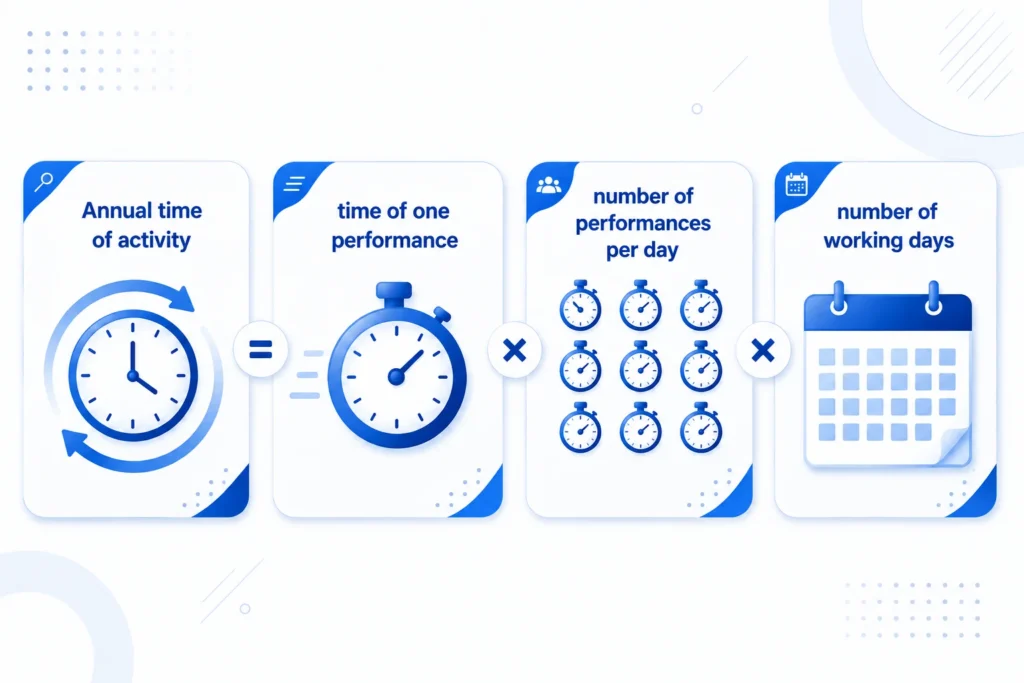
Then calculate how much of that time can realistically be recovered and apply the actual labor cost used by your company.
Hypothetical example
A shift report is prepared three times a day. Assume that preparing one report currently takes 35 minutes and that automation reduces this to 10 minutes. With 250 working days per year, the difference would be:
3 × 25 minutes × 250 days = 18,750 minutes, or 312.5 hours per year.
Only then should this value be compared with the cost of implementing and maintaining the solution. This type of calculation is more credible than universal claims about payback periods because the actual result depends on the size of the plant, the number of users, the scope of integration, and the amount of work that is genuinely eliminated.
Efficiency in production starts with data, but ends with a decision
A dashboard by itself does not improve performance. Data becomes valuable when it helps identify a cause and points to an action.
If OEE shows a decline in availability, you still need to determine why. “Waiting” is also too broad as a category. Production may have been waiting for material, maintenance support, a changeover, quality approval, or documentation, and each of these situations requires a different response. A useful way to assess maturity is through the following five levels, where you:
- Know the result: you know how much was produced.
- Can see the loss: you measure downtime, quality, and performance.
- Understand the cause: you can assign the loss to a specific event.
- Trigger a response: the data reaches the person responsible for taking action.
- Connect information more broadly: data can be exchanged between systems, plants, and business partners.
Efficiency in production can therefore be understood as a company’s ability to identify losses and turn process data into actions that reduce those losses.
Where do data spaces in manufacturing fit into this?
Once a plant has organized its internal data, the next step may be to exchange that data securely beyond company boundaries. A manufacturer may need information from a supplier, a customer may require traceability, and quality or product data may need to be shared among multiple participants in the value chain.
Data spaces in manufacturing support this type of controlled data exchange. The Data Spaces Support Centre describes data spaces as environments based on shared principles for governance, interoperability, and control over the conditions under which information is shared.
A data space should not be the first stage of a plant’s digital transformation. If data inside the company still has to be manually re-entered and does not have a defined owner or context, the internal information process should be organized first.
Where should you start improving efficiency in production?
Choose one process that regularly consumes time or limits your ability to meet the production plan. It could be a shift report, a material request, downtime handling, quality reporting, or access to documentation.
Next, measure how the process currently works and determine where the loss occurs, who is responsible for it, and which result will confirm that an improvement has actually been achieved. Only then should you decide which technology to use.
If your existing data does not make it possible to identify the constraint, you can start with process analysis. First find and quantify the loss, then select the tool that removes it. This sequence helps distinguish an investment that production actually needs from one that merely looks like the next logical stage of automation.

FAQ
Is OEE enough to assess efficiency in production?
OEE is useful for measuring equipment utilization through availability, performance, and quality. However, it does not capture all losses associated with information flow, internal logistics, documentation, and administrative work.
Does production automation always mean robotics?
No. Reporting, machine data collection, material requests, documentation, traceability, and information exchange between departments can also be automated.
What are data spaces in manufacturing?
They are environments that enable controlled data exchange between independent companies according to shared technical and organizational rules. Data spaces in manufacturing are particularly useful when a company already has well-organized internal data.
Schedule a free workshop, and we’ll help you identify opportunities to improve efficiency in production at your factory.
Learn more about modern manufacturing in other articles on the explitia blog.