

ISA-95: Organize MES, ERP, and Manufacturing Data
ISA-95 helps define which information should originate on the shop floor, what should be managed by the MES, and what should remain in the ERP system. The standard also provides a structured way to describe production orders, materials, equipment, and manufacturing results. In this article, you will learn how to interpret the ISA-95 levels, where the MES system fits within the model, and how ISA-95 can be combined with OPC UA.
What Is ISA-95?
ISA-95 is an international standard for integrating business systems with manufacturing management and control systems. It is also published as the IEC 62264 series of standards.
The ISA-95 standard provides a structured model of how a manufacturing company operates. It defines the responsibilities of individual system layers and the information that should be exchanged between them. One of its most important purposes is to distinguish manufacturing operations management systems, such as MES and MOM, from enterprise business systems such as ERP.
However, ISA-95 is not a ready-made application, a communication protocol, or an implementation design. It does not recommend a specific software vendor or solution. Instead, it provides a common framework that helps companies organize cooperation between different systems.
It gives manufacturing, automation, and IT teams a shared model for agreeing on:
- which system is responsible for specific information,
- where decisions should be made,
- how manufacturing resources should be described,
- which data should flow between ERP and MES,
- how production performance should be reported.
This distinction is essential because simply connecting two applications does not guarantee that they will interpret a production order, workstation, material batch, or downtime reason in the same way.

Why Do Manufacturing Companies Use ISA-95?
ERP systems store information about orders, products, materials, and planned deadlines. Controllers collect data directly from machines, while the MES records the progress of production orders. Quality inspection results are often stored in a separate system. As a result, a complete view of manufacturing is only available after data from several sources has been combined.
The data is distributed across multiple systems because each system describes a different stage of the same process. The gap becomes visible when a company tries to answer seemingly simple questions:
- What is the actual status of the production order?
- Which material batch was used to manufacture a specific product?
- Why was the production plan not completed?
- How many units are finished, and how many require rework?
- Has the ERP system received the latest production data?
- Which system contains the correct version of the information?
Without clearly defined rules, the answers often depend on a spreadsheet, a manual entry, or the knowledge of a single employee.
ISA-95 helps separate system responsibilities. It also makes it possible to prepare MES and integration requirements without starting the discussion with screen layouts, database tables, or specific interfaces.
Among other applications, ISA-95 can provide a foundation for defining user requirements, evaluating vendors, and designing MES systems and databases.
ISA-95 Levels: From the Physical Process to ERP
The best-known element of the standard is its division into Levels 0 through 4. This structure is often presented as an automation pyramid.
However, the model should not be treated as a rigid infrastructure diagram. Its primary purpose is to illustrate the scope of activities and responsibilities.
| Level | Responsibility | Examples |
|---|---|---|
| 0 | Physical manufacturing process | Assembly, machining, material handling, temperature changes |
| 1 | Measurement and direct process interaction | Sensors, actuators, drives |
| 2 | Control and supervision | PLCs, SCADA systems, HMI operator panels |
| 3 | Manufacturing operations management | MES, MOM, quality management, maintenance, and materials management |
| 4 | Business planning and logistics | ERP, purchasing, sales, finance, production planning |
Industrial automation systems are mainly associated with Levels 1 and 2. Manufacturing operations management belongs to Level 3, while ERP primarily operates at Level 4. Level 0 represents the physical manufacturing process itself.
In a real manufacturing plant, the boundaries do not always follow this model exactly. An advanced ERP system may include scheduling functions, a controller may store recipe parameters and production counters, and an MES may be expanded to include maintenance or quality control.
Before assigning an application to a specific level, it is therefore important to consider what decisions the system makes, which data it uses, and which area it is responsible for.
ERP is generally used for business-level planning and accounting. Level 3 responds to the real-time progress of shifts, operations, and production orders, while Levels 1 and 2 handle machine control and process-related responses.
MES in ISA-95 Connects Planning with Execution
The MES system is primarily located at Level 3 of the ISA-95 model. Its role is to manage manufacturing execution and exchange information between ERP and the shop floor.
The ERP system may send the following information to the MES:
- production order number,
- product and product version,
- planned quantity,
- due date,
- required materials,
- batch information,
- planned production process.
The MES uses this information to guide the production order through successive operations. It records completed quantities, working time, downtime, material consumption, inspection results, and the employees involved in execution.
After an operation or the entire production order has been completed, the system sends the actual production data required for accounting and settlement back to the ERP system.
Example of Data Flow Between ERP and MES
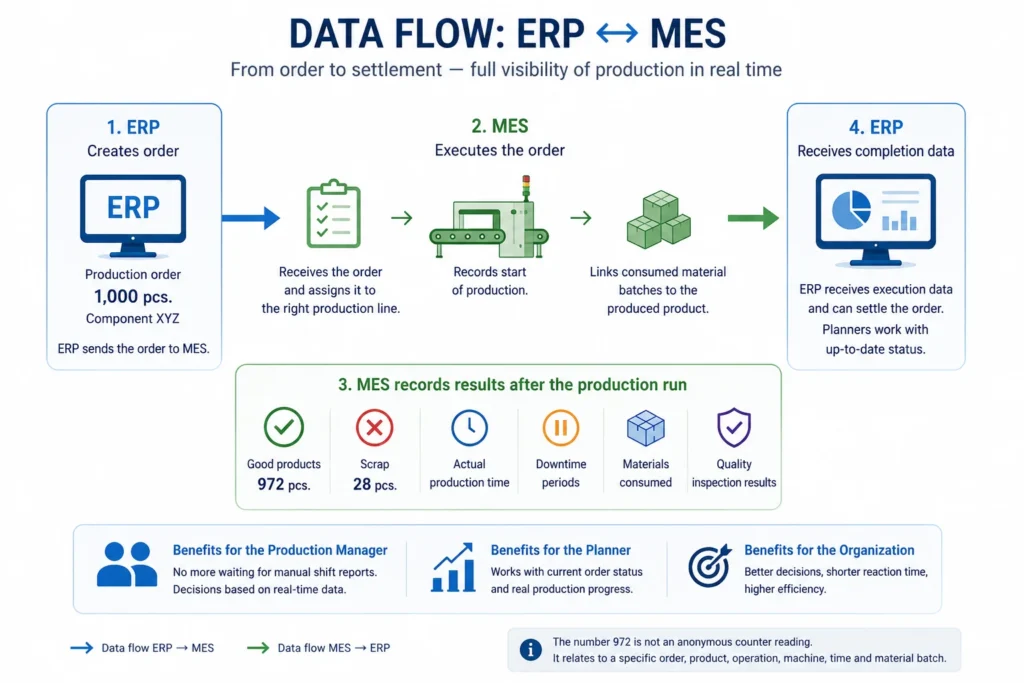
The ERP system creates a production order for 1,000 components and sends it to the MES. The manufacturing system assigns the job to the appropriate production line, records the start of work, and links the consumed material batches with the manufactured product.
After the production run is completed, the MES records:
- 972 good units,
- 28 defective units,
- actual operating time,
- downtime periods,
- materials used,
- quality inspection results.
The ERP system receives the production results and can settle the order. The production manager does not have to wait for a manual report prepared after the shift, and the production planner works with the current order status.
The value of an MES comes from preserving context. The number 972 is not an anonymous reading from a machine counter. It relates to a specific production order, product, operation, machine, time period, and material batch.
MES vs. MOM: Why Are There Two Terms?
MES, or Manufacturing Execution System, focuses on managing the execution of manufacturing processes. MOM, or Manufacturing Operations Management, refers to the broader scope of Level 3 operations.
ISA-95 divides this area into four main groups of activities:
- production operations management,
- quality operations management,
- maintenance operations management,
- inventory and material operations management.
Systems marketed as MES solutions can differ significantly in their functional scope. For this reason, the product name alone is not enough to evaluate its actual capabilities.
When selecting a solution, companies should review its specific functions, data model, and process responsibilities. ISA-95 helps define these requirements without relying on the terminology used by a particular software vendor.
ISA-95 Organizes the Meaning of Manufacturing Data
Integration is often evaluated mainly from a technical perspective. One system sends a message, another system receives it, and the interface is considered operational. However, many errors result not from transmission problems but from differences in the meaning of the data.
An ERP system may treat “Line 1” as a cost accounting location. The MES may require a hierarchy consisting of a plant, area, line, workstations, and equipment. A controller, on the other hand, recognizes specific machine signals such as running, stopped, or cycle completed.
ISA-95 defines models that help organize:
- equipment and equipment hierarchies,
- physical assets,
- personnel and qualifications,
- materials and material classes,
- production capabilities,
- schedules and production orders,
- production responses.
The standard defines information that is common across many industries. Data specific to a particular plant, application, or process can be extended through additional properties.
Before building an integration, companies should therefore establish clear identifiers, data owners, and data update rules. If the production order status can be changed by ERP, MES, and an operator using a spreadsheet, another interface will preserve the inconsistency rather than eliminate it.
ISA-95 and OPC UA: How Do They Work Together?
ISA-95 describes the organization of manufacturing activities and the meaning of production information. OPC UA provides mechanisms for communication and data modeling.
However, the two standards serve different purposes. OPC UA can transmit a reading, event, or command between a device and a higher-level system. ISA-95 helps determine what the transmitted information represents and which resource, production order, or material it should be associated with.
A counter reading of 972 has limited value on its own. Only the appropriate context indicates whether it represents good units, defective units, machine cycles, the quantity produced since the start of a shift, or the output of a specific production order.
The OPC Foundation has developed companion specifications that represent ISA-95 elements using OPC UA objects, variables, data types, references, and methods. These models include equipment, physical assets, personnel, and materials.
The OPC UA for ISA-95 Job Control specification also describes the handling of jobs, job responses, and access to the status of pending, active, and completed work.
Example Division of Responsibilities
- ERP sends a production request or production order.
- MES expands it to the operation level, assigns resources, and maintains the execution context.
- OPC UA can transfer data between MES, SCADA, a controller, or a device.
- ISA-95 helps define the objects and information used in this data flow.
OPC UA does not replace ISA-95, and ISA-95 does not compete with OPC UA.
Does ISA-95 Require B2MML?
In a word, no. B2MML is an XML-based implementation of ISA-95 models used to exchange data between business and manufacturing systems.
B2MML is not mandatory. The same information model can be exchanged through APIs, messages, files, or an integration platform. The content and meaning of the data should be agreed upon first, followed by its technical format.
What Does ISA-95 Provide for a Manufacturing Company?
When used correctly, the model makes it easier to define boundaries between systems. ERP does not have to take over the control of production line operations, and the controller does not become the source of the business-level status of a production order.
This can help reduce:
- manual re-entry of production results,
- conflicting resource identifiers,
- point-to-point integrations,
- errors in material accounting,
- dependence on the knowledge of individual employees,
- the cost of connecting additional production lines.
It also becomes easier to establish effective manufacturing traceability. Data about materials, operations, equipment, and results can form a single, consistent record of the production process.
The standard itself will not guarantee improvement. The outcome depends on whether data owners and systems of record are clearly defined. A vendor’s claim of ISA-95 compliance does not replace a detailed process analysis.
How to Prepare for an ISA-95-Compliant MES Implementation
A good starting point is a single production order. The order should be traced from its creation in the ERP system through manufacturing execution to final production accounting.
During the analysis, check:
- Where is the production order created?
- Which system stores its current status?
- What triggers work on the production line?
- Where does the completed quantity come from?
- How are defective units and rework recorded?
- Where are material batches registered?
- Which system stores quality results?
- How is the data returned to the ERP system?
- Which information is entered manually?
- Who is responsible for data definitions and data quality?
Based on this analysis, you can prepare the target data flow and define the required MES scope. During discussions with software vendors, ask them to demonstrate how their system handles:
- a process or routing change,
- a production order correction during execution,
- a new product version,
- material substitution,
- the connection of another production line,
- product genealogy,
- a loss of connection with the ERP system,
- retransmission of a message without creating duplicate data.
These questions quickly reveal whether the solution is based on a well-designed information model or on a collection of custom point-to-point integrations.
When Should You Start with a Workshop Instead of Selecting a System?
An analytical workshop may be a good choice when you cannot clearly identify the source of the production order status, production results are reported manually, or different departments define the same resources in different ways.
Selecting an MES without first organizing these issues may simply transfer existing inconsistencies into the new system.
A good workshop should produce the following materials:
- a map of the current information flow,
- a list of data sources,
- a division of responsibilities between ERP, MES, and automation systems,
- a model of the most important objects,
- an integration scope,
- a list of vendor requirements.
Are you planning an MES implementation or organizing ERP integration? Start by analyzing a single production order. The explitia team can help you identify data sources, system boundaries, and the scope of the required interfaces.
See how the Production Portal can help your plant operate in accordance with the ISA-95 standard.
One Principle Worth Remembering
ISA-95 provides the greatest value when it supports decisions about data and system responsibilities.
Trace one production order from planning in ERP, through execution on the production line, to material and quality accounting. Every manual entry, delayed status update, or ambiguous identifier will point to an area that needs to be organized.
FAQ: ISA-95, MES, and OPC UA
Is ISA-95 Mandatory?
ISA-95 is not generally required by law. It is a reference standard used when designing integrations between business systems and manufacturing management and control systems. ISA-95 is also published as the IEC 62264 and PN-EN 62264 series of standards.
Are ISA-95 and IEC 62264 the Same?
ISA-95 and IEC 62264 cover the same area of enterprise integration with manufacturing control and operations management systems. The term ISA-95 is commonly used in industry publications, while IEC 62264 is used within the international standardization system.
Is Every MES ISA-95 Compliant?
No. A vendor may use ISA-95 terminology or implement selected ISA-95 models. You still need to review the system’s functional scope, data structure, and integration methods for ERP and industrial automation.
Does ISA-95 Replace MES?
No. ISA-95 is a standard and reference model. MES is software that performs selected manufacturing operations management activities.
MES or MOM: Which Term Is Correct?
Both terms are correct, but they have different scopes. MES focuses mainly on manufacturing execution. MOM covers a broader range of operations, including production, quality, maintenance, and materials management.
Does OPC UA Replace ISA-95?
No. OPC UA is used for communication and information modeling. ISA-95 organizes activities, objects, and information flows between enterprise system layers.
Where Should You Start with ISA-95?
Start by tracing a single production order and determining which system is responsible for each stage and each piece of information. Only then should you design interfaces and select integration technologies.
Tell us how ERP-MES communication works at your plant.
Read the explitia blog and discover new ways to improve your manufacturing processes.