

Manufacturing Process Examples: How to Describe Production and Find Losses Faster
A manufacturing process helps answer one of the most important questions in production: how exactly was the product made, the one that has just left the line, reached quality control, or come back as a customer complaint? In this article, we go through manufacturing process examples to show what is worth documenting, what data to collect, and where time, quality, and control over a job most often slip away.
This text may be especially useful for people responsible for production, engineering, quality, and planning. Especially for those who know the situation where documentation says one thing, the shop floor does another, and the real history of a job has to be reconstructed from conversations, spreadsheets, and scattered records.
We will show you manufacturing process examples from different industries.
A manufacturing process is more than the order of operations
In simple terms, a manufacturing process is a sequence of operations that turns raw material, a semi-finished product, or a component into a finished product. In production, that may mean cutting, bending, welding, milling, assembly, dosing, packaging, testing, or quality control.
That definition is correct, but for someone managing production, it is not useful enough. In day-to-day work, what matters more is whether the process can be repeated, measured, and reconstructed later.
If a product does not meet requirements, it is not enough to say that it went through assembly or was sent to the paint shop. You need specific information, such as material, workstation, operator, parameters, operation time, inspection result, and documentation version. Without that, quality analysis starts to feel like looking for a cause in traces that have already been partly erased.
Metal fabrication: the biggest losses often sit between workstations
In a company producing metal parts, the manufacturing process may look like this: sheet cutting, bending, welding, grinding, painting, dimensional inspection. On a process map, everything looks logical. In a real job, the biggest issue may not come from any single operation.
After cutting, the part waits for bending because the workstation is still working on the previous batch. After welding, it joins the queue before grinding, and the paint shop is blocked by another priority. The plan includes a standard time for each operation, but it does not show how long the job spent waiting, looking for tools, or requiring an extra machine setup.
In this kind of process, the process routing sheet alone will not solve the problem if it only describes the path of the product. You also need to see transfer times, changeovers, downtime reasons, and workstation load. Only then can you reasonably determine whether the job is late because of an inaccurate standard, a missing resource, a poor work sequence, or a planning issue.
In metal fabrication, a good process description should connect engineering with the rhythm of the shop floor. The list of operations answers what needs to be done, but execution data shows where production is actually losing time.
Subassembly: a parameter in the routing sheet needs proof in the data
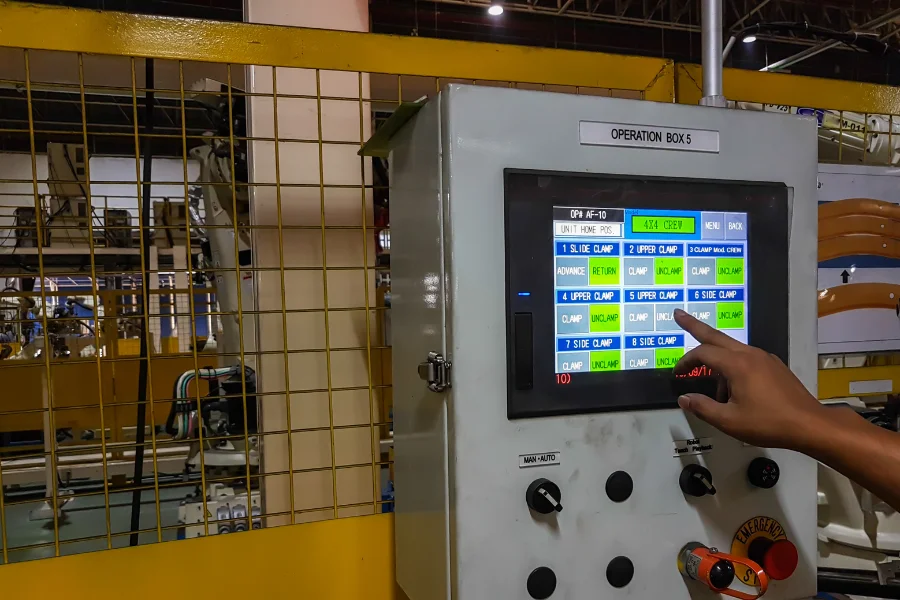
In subassembly, the process may be shorter, but not necessarily simpler. Kitting, assembly, tightening, functional testing, and product labeling may take little time and still create significant quality risk.
One parameter that cannot be confirmed after the fact is enough. The process routing sheet specifies a tightening torque of 12 Nm. The operator completes the assembly, and the final test is positive. A few weeks later, the customer reports a problem.
At that point, the document with the parameter may not be enough. You need a record showing that the right tool was used for the product, with the right setting, at the right workstation. If that trace does not exist, inspection has to cover a wider batch range, the cost of investigation rises, and the response to the customer is delayed.
In assembly, a manufacturing process works well when documentation and execution records meet at a specific product number, batch, or job. Without that, even a correctly written instruction cannot provide full confidence.
Food production: the batch matters more than a single package
In food production, the manufacturing process may include dosing, mixing, heat treatment, cooling, packaging, and weight control. The batch usually becomes the center of attention because one process parameter can affect many packages.
If the heat treatment temperature deviated from the target, the risk range has to be checked.
- Which raw materials went into the batch?
- How long did the stage take?
- Did cooling follow the requirement?
- What were the inspection results, and when were they recorded?
With good traceability, the company can narrow the analysis. With weak traceability, it has to look wider than the actual risk may require. That means more holds, higher cost, and harder communication with the customer or recipient.
The organization of the manufacturing process in this kind of plant depends on the flow of information between the recipe, raw material batch, process parameters, and inspection. A spreadsheet may be enough at a small scale, but with more batches and shorter response times, it starts to become a limitation.
Plastic injection molding: a small parameter deviation can change the result of a run
In plastic injection molding, the same product may look correct in the plan and still cause problems in a specific run. The process includes mold preparation, machine setup, injection, cooling, part removal, finishing, and visual inspection.
Quality depends on parameters that are not always visible in the finished part right away: temperature, pressure, cooling time, mold condition, and material properties. If the scrap rate starts rising, the reject count gives a signal, but it does not point to the cause.
Here, the manufacturing process should make it possible to compare machine settings with quality results.
- When did defects start increasing?
- Did the resin batch change?
- Had the mold just been cleaned?
- Was the cycle time shortened?
Without this data, the team quickly has to rely on the memory of operators and shift leaders. With stable parameter records, you can move to facts and check which setting coincided with the drop in quality.
See where your manufacturing process loses time, data, and control.
What connects these manufacturing process examples?
Metal fabrication, assembly, food production, and injection molding differ in technology, but they follow a common pattern. In each case, the description of operations has to be connected with execution data.
A manufacturing process should show:
This list only works if it leads to action. If a company records data that no one uses, it adds work. If it fails to record the data needed to explain a complaint, it makes its own response harder.
The most important question is whether, after a week, a month, or a quarter, you can check how a specific product was made.
A process routing sheet should be shorter than the problem it solves
A process routing sheet should describe how to make a product so that production, engineering, quality, and planning work from the same assumptions. It should include the product version, operations, workstations, machines, tools, parameters, time standards, quality requirements, and the method for recording results.
It does not need to be detailed for the sake of completeness. A long document that no one uses is a waste of time. On the other hand, a document that is too general leaves too much room for interpretation.
The greatest damage comes from an outdated routing sheet. A parameter changed after a complaint, a new operation sequence, a different tool, or a corrected time standard must make it into the official version. Verbal information helps only for a while, and after a team change, vacation, or employee turnover, the question returns: which version was the right one?
A process routing sheet should be a living document, but without excess. It should answer only the questions that actually come up during a job.
A manufacturing process without data quickly turns into guesswork
Planning may assume a specific operation time, engineering may describe the parameters, quality may define inspection criteria, and production will still show its own version of the truth if a machine stops, material arrives with a deviation, or a changeover takes longer.
Shop floor data is not needed to create another report. The point is to connect the plan with execution. ERP usually stores information about the product, job, and batch, while MES can record operation status, times, downtime, parameters, and production results. Spreadsheets often patch gaps between these systems, but at a larger scale, they make fast analysis harder.
OEE can be helpful because it combines availability, performance, and quality. It shows whether the loss comes from downtime, slower work, or defects. The percentage alone is not enough. Only when it is connected to a specific manufacturing process does it point to the area that needs improvement.
If a company only knows the final result, it reacts late. If it can see the process as it happens, it can respond earlier.
How to check your own process on one job
The best test does not require a broad audit. Choose one job and follow its path from material to inspection.
Start by checking whether the documentation matches what was actually done. Then compare the planned time with the real execution. Pay attention to places where information is entered manually, passed verbally, or available only from one person.
A good sign is the ability to reconstruct the batch quickly. If you know what material was used, who performed the operation, what parameters were applied, and what the inspection result was, the process has a solid starting point for improvement. If the answers require several conversations and digging through multiple files, the biggest gap is in the flow of data.
It is best to start this test with a product that often returns to production, generates complaints, or has a major impact on on-time delivery. One well-described process becomes a model for the next ones.
The best process description helps reduce the cost of uncertainty
A quality issue costs more than material. Rework, sorting, extra inspections, delays, people’s time, and the risk of losing customer trust all add up. The later you find the cause, the wider the investigation becomes.
A manufacturing process reduces that cost when it lets you move from the symptom to the source of the problem. A complaint does not end in a broad review of many batches, and a delay is not explained with one sentence about production load. Defects are not just a number in a report.
A well-described process leads to specific information: batch, operation, parameter, workstation, tool, shift, or inspection point.
If data on jobs, downtime, parameters, and quality is scattered, explitia solutions can help connect it into one view of production.
FAQ
What is a manufacturing process?
A manufacturing process is an organized sequence of operations that turns raw material, a semi-finished product, or a component into a finished product. It includes the method of execution, parameters, workstations, tools, and quality control.
What are examples of manufacturing processes?
Manufacturing process examples include metal fabrication, subassembly, food production, plastic injection molding, painting, packaging, and quality control.
What is the difference between a manufacturing process and a production process?
A production process covers the full execution of a product, from planning to shipment. A manufacturing process refers to the operations that directly affect the product or confirm that it meets requirements.
What does a process routing sheet include?
A process routing sheet includes operations, workstations, machines, tools, parameters, time standards, quality requirements, inspection points, and the method for recording results.
How can you improve a manufacturing process?
It is best to start with one repeatable product. Compare the documentation with actual execution, then check parameter records, operation times, downtime, and the ability to reconstruct the batch.
Want to detect downtime, defects, and plan deviations faster?