


Technological process – examples from the dairy industry. What does modern production look like step by step?
Perhaps you have never wondered what a technological process actually is – examples from many manufacturing companies show that a well-designed technological process is like fuel for a car. Its precision, level of automation and discipline determine not only quality, but above all product safety. In the dairy industry, where raw material is sensitive to temperature changes and contamination, the stages of the technological process are controlled with micrometric accuracy.
If you are looking for an answer to the question of the subsequent stages of a technological process, this article is for you. Using the dairy industry as an example, we explain how raw milk, straight from the cow, is transformed into a product ready for consumption.
What exactly is a technological process?
In the simplest terms, a technological process is a logical and strictly defined sequence of physical, chemical and biological operations aimed at transforming raw material into a finished product with precisely defined characteristics (taste, texture, shelf life, safety).
In the technological process in the food industry, especially in dairy processing, it is crucial to control individual parameters often referred to as Critical Control Points (CCP). Particular attention is paid to:
- time – determines the intensity of heat treatment (e.g. LTLT, HTST, ESL, UHT) and fermentation time;
- temperature – the most important factor affecting microbial activity and product safety;
- pH/acidity – a key parameter for determining the moment fermentation should be stopped.
That is why modern production, based on quality systems such as HACCP, is impossible without advanced industrial automation and digital control systems. They ensure precise control over Critical Control Points (CCP), which translates into repeatability, optimization of resource consumption and full traceability (batch tracking).

Technological process in the dairy industry – preliminary stages
1. Raw material collection and initial quality control
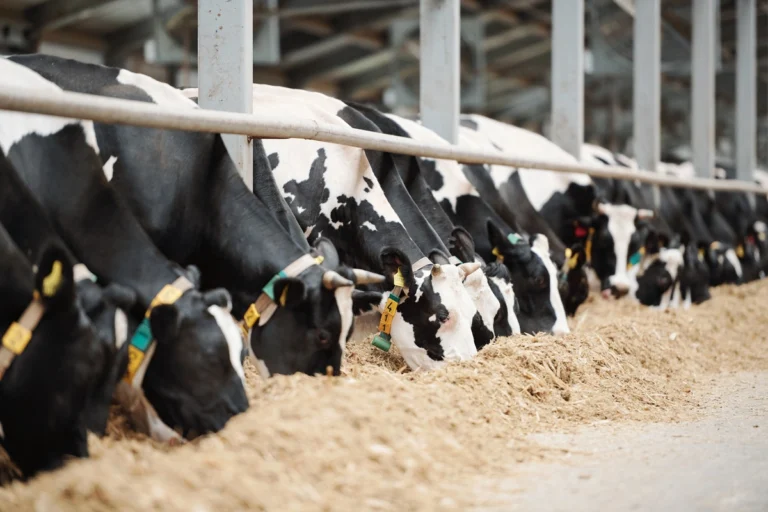
The modern technological process in industry does not begin on the production line, but on the farm.
After milking, milk is immediately cooled in special cooling tanks to a temperature of 2–6°C, which is crucial to minimize the growth of psychrotrophic microflora and preserve quality parameters.
The tanker truck driver, often transporting milk in compartmentalized tanks to maintain traceability and prevent mechanical damage to fat globules (which could lead to butter formation), is required to take a sample from each batch for analysis.
The first and most important test, carried out already at reception, is a rapid antibiotic test. A positive result, even for trace amounts of antibiotics, immediately disqualifies the entire batch of milk and prevents its acceptance by the plant. Only after successful verification can the milk be transferred to chilled storage tanks.
2. Standardization and fractionation – raw material division
Stored milk is directed to the first stage of processing, which enables the production of almost the entire dairy product range. This phase includes two processes: separation and fat standardization, involving the division of whole milk into fractions with different fat contents.
The milk is heated (usually to approximately 45–55°C) and subjected to centrifugation in disc separators. As a result, it is divided into two key streams:
- cream – a fat concentrate;
- skim milk – a base with almost zero fat content.
Thanks to this, the plant can precisely standardize (normalize) products – from 3.2% and 2% milk to yogurts and cheeses.

Want to see how automation and MES systems genuinely improve the technological process in a dairy plant?
Let’s talk about your production facility. Contact us or schedule a Free 360° Workshop.
Technological process – example: liquid milk production (UHT)
UHT (Ultra High Temperature) milk is a product that best illustrates a technological process ensuring a long shelf life while preserving nutritional value. Three stages can be distinguished:
- Homogenization – a very important process applied to milk during processing. It involves subjecting milk to very high pressure, which breaks down large fat globules into smaller ones. The result? Milk has a uniform structure, cream does not rise to the surface, creaming (phase separation) is prevented and proteins are stabilized.
- UHT sterilization – a process involving rapid heating of milk to a temperature of 135–150°C and holding it for only 2 to 5 seconds. This temperature allows the required sterilization effect (F0) to be achieved and destroys all microorganisms and their spores, ensuring product stability for many months.
- Aseptic packaging – after sterilization, milk must be cooled and filled in an aseptic (sterile) environment. Multilayer packaging provides a barrier against light and air, eliminating the need to store UHT milk in a refrigerator.
Technological process in industry – example of cottage cheese production
Cottage cheese production is a more complex technological process in which controlled lactic fermentation plays a key role. The production of cottage cheese can be divided into four phases.
- Preparation and pasteurization of the base – skimmed (or standardized) milk is pasteurized to destroy undesirable microorganisms and to denature whey proteins (which increases yield and water binding), then cooled to fermentation temperature (20–25°C).
- Addition of bacterial cultures – selected lactic acid bacteria cultures are added to the base, initiating the conversion of lactose (milk sugar) into lactic acid. The drop in pH and increase in acidity cause coagulation – milk proteins curdle, forming a curd.
- Curd processing and whey separation – once the curd reaches the appropriate acidity (pH signals the end of fermentation), the key process of whey separation begins. How is this done? Modern plants no longer use sieves or cloth bags – curd centrifuges or presses are used to separate the solid curd mass from liquid whey.
- Final product formation – the drained curd can be directed to the production of:
- homogenized cheese desserts – to obtain the final product, the curd is mixed with cream, sugar and fruit preparations in mixing stations until a smooth consistency is achieved;
- block cottage cheese – here the curd mass is formed, cut and packaged.
Automation of the technological process
All stages of the technological process in a modern dairy plant are controlled by PLC/SCADA systems and managed by integrated automation systems (MES/ERP). The role of humans is limited to supervision and data analysis.
Traceability is particularly important – the ability to track the product history throughout the entire production path. Traceability systems help control time and temperature by recording data for each batch, enabling full product tracking (from raw material collection to placement on the store shelf) and, in case of an issue, rapid withdrawal of a defective batch from the market.
Production plants also use CIP (Cleaning In Place) systems. Thanks to them, equipment cleaning takes place automatically without the need for disassembly, saving time and water while ensuring the highest level of hygiene.
Explitia’s experience in automating the food industry shows that the dairy sector, with its sensitive raw material, is a model technological process for us – an example of precision and innovation. Digital supervision of parameters such as temperature, time, pH and pressure is essential to ensure that the final product is not only tasty, but above all safe and compliant with strict standards.
Wondering what a modern technological process looks like in practice? Contact us and see real implementation examples.