


Modern Quality Control in Industry 4.0: Technologies, Automation and the Role of Quality Teams
Industry 4.0 has changed the way we think about manufacturing. It has also changed the way we think about quality control. Increasingly, it becomes the result of continuous data analysis, automatic anomaly detection and fast reactions from real-time systems. It is a completely new model in which technologies, human competencies and process organization merge into one ecosystem. The effect? Production becomes predictable, repeatable and resistant to errors.
In traditional approaches, the quality controller would “catch” non-conformities at the end of the line. In the digital model, it is difficult to imagine that problems would go unnoticed in earlier stages of production. All irregularities should be identified and eliminated much earlier. Companies that consciously use modern quality control tools gain not only lower cost of poor quality, but also greater flexibility, more stable performance and a visible competitive advantage.
Modern technologies that redefine quality
In recent years, a technological breakthrough has occurred. Systems that were once available only in highly regulated industries are now becoming standard in plants of all sizes. Below is an overview of key technologies changing the approach to modern quality control.
MES in modern quality control
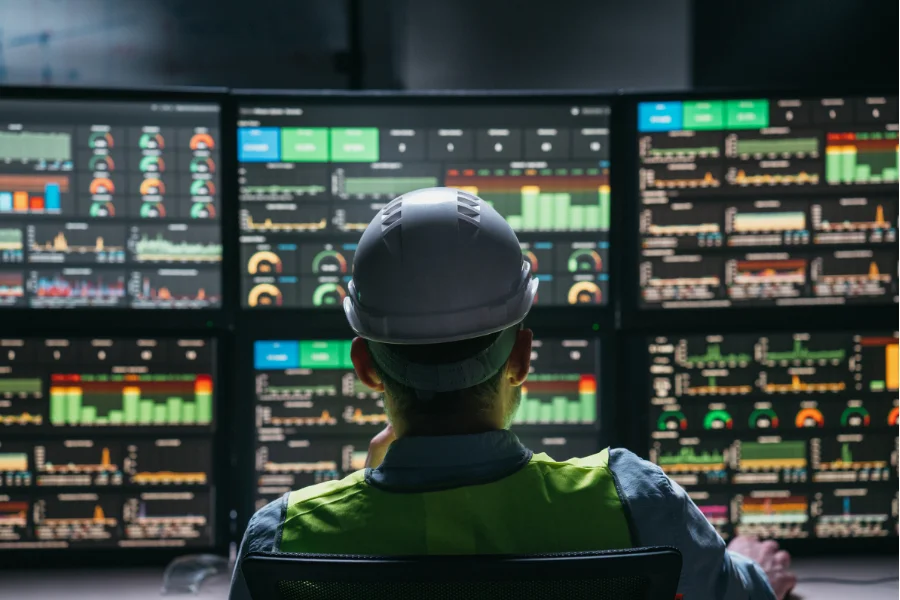
The MES (Manufacturing Execution System) is one of the most important elements of digital transformation in manufacturing. Its role in the quality area is fundamental because it allows processes to be monitored in real time and deviations to be addressed before they grow into serious problems.
MES collects data from machines, sensors, automation systems and measurement devices. As a result, quality is no longer based only on periodic inspections – it becomes a daily indicator of how production truly operates. This approach allows companies to:
- detect deviations in process parameters,
- immediately stop the line when a non-conformity appears,
- analyse trends that signal upcoming issues,
- link quality with line performance and production planning.
In practice, this means reduced waste and stable line operation. In this sense, MES is a guardian of quality – working continuously and responding faster than any team member could.

Want to take your quality control to the next level?
Discover how to use an MES system in quality control!
Vision systems in quality control
The second pillar of automated quality control are vision systems. With high-resolution cameras and image-analysis algorithms, they detect microscopic defects invisible to the human eye – especially at high production speeds.
Their advantages include:
- full repeatability,
- very high precision,
- resistance to fatigue and working conditions,
- ability to operate at speeds unreachable for humans.
In the food industry, vision systems detect damaged packaging. In automotive – micro-cracks and dimensional deviations. In electronics – insufficient soldering, short circuits or contamination that could lead to device failure.
Vision systems do not replace the quality controller. They simply change the scope of their work, enabling them to focus on data analysis, process improvement and supervision.
Internet of Things (IoT) and digital twins
IoT introduces a missing element into quality control: complete, up-to-date information about the state of processes and equipment. Sensors record temperature, pressure, vibration, speed, force, humidity and other key parameters in real time. These data can immediately be analysed, anomalies detected and corrections implemented.
IoT has another significant application – it enables the creation of digital twins. These virtual models of processes allow organisations to:
- simulate changes,
- test production variants,
- predict machine behaviour,
- optimise processes without risk.
This is a powerful tool for quality, R&D and production departments. It makes it possible to solve problems before they appear on a physical line.
Predictive Maintenance in the service of quality
Predictive Maintenance is one of the most promising technologies of recent years. Its goal is to predict failures based on machine data. Failures almost always affect quality — vibration, looseness, wear, leaks or micro-vibrations can lead to errors in execution.
Therefore, prediction supports quality indirectly, but critically:
- reduces the number of breakdowns,
- minimizes the risk of defects caused by worn-out components,
- shortens downtime,
- increases machine life,
- stabilizes the production process.
This proves that quality does not depend only on inspection. It also depends on the condition of the machine park.
Quality organization – from procedures to intelligent processes
Aside from technologies, the way the quality function is organized is equally important. Traditionally, the quality department was responsible for inspection, reporting and reacting to errors. Today, its role shifts toward analytics, prevention and cross-department coordination.
An effective quality system is based on:
- clearly defined responsibilities,
- work standards and instructions,
- automated entries, measurements and reports,
- a culture of quality among employees,
- data analysis,
- fast reaction to deviations.
QMS systems structure the work of the department, automate reporting and enable full quality traceability. Integration of QMS with MES and ERP connects quality with planning, production and logistics.
Costs vs. quality
Quality costs – that is obvious. But the lack of quality costs far more. Companies that can analyse the costs of quality gain both financial and operational advantages.
Quality costs are related to expenditures that can be divided depending on their purpose:
- prevention of quality decline – training, analyses, planning;
- quality evaluation – inspections, tests, audits;
- internal failures – scrap, rework, downtime;
- external failures – complaints, returns, reputational loss.
The goal of a quality system is to move budget from the last two categories into the first two – from reaction to prevention.

Role of the quality controller: new competencies, new reality
Automation does not eliminate the human role in quality. It changes it. The modern quality controller becomes an analyst, an operator of digital systems and a partner for production, maintenance and technology departments.
Today’s quality controller needs:
- knowledge of SPC,
- data-analysis skills,
- ability to work with MES/ERP/QMS systems,
- technological understanding of processes,
- communication and decision-making skills.
The expectation is not only to detect errors but to understand their causes and actively participate in eliminating root problems.
Managing the quality department in a digital factory
A modern quality department must operate like an analytical-technological unit – not just a control function. In practice, this means:
- strategic planning of quality activities,
- integration of processes,
- data-driven work,
- fast reaction to deviations,
- regular audits and process reviews,
- collaboration with maintenance and production,
- deployment of automation tools.
To reach high maturity, the quality department must co-create production strategy – not just enforce it.

Digitalization and automation of quality control – new perspectives
The coming years will bring even greater integration of quality with digital systems. Key trends include:
- AI-based anomaly-detection systems,
- predictive quality models,
- autonomous inspection systems,
- development of digital process twins,
- full integration of quality data with ERP, MES and IoT,
- increasing role of data analytics in operational decisions.
Companies that start building quality systems on these foundations today will be ready for the next stages of industrial transformation.
Modern quality control is no longer an add-on to production – it is its essential part. Integration of technologies, systems and human competencies makes quality a continuous, intelligent and predictable process. Industry 4.0 does not diminish the importance of quality – it strengthens it, making it a pillar of efficiency and production safety.
Wondering which technologies to use in quality control? Write to us and our experts will get in touch with you!