

SLA – Technology support after IT system implementation
When discussing the digitalization of manufacturing plants and process optimization, attention naturally tends to focus on the early stages: pre-implementation audits, technology consulting, as well as system design and deployment—such as MES-class solutions. These are, without doubt, crucial steps that form the foundation of digital transformation in manufacturing.
But the real life of a system—and its actual value—begins only once it goes live on the shop floor, supporting employees in their day-to-day tasks. And then the questions arise:
- What happens when a failure occurs during the night shift and production comes to a halt?
- How should the team react when, at 10 p.m., an operator mistakenly selects the wrong parameter on the panel, disrupting the system?
- What if an external system sends incorrect data because of a simple human error during entry?
That’s why, once the implementation phase ends, another equally important stage must begin—ongoing technology support.
Of course, service care is not limited to crisis management. Planned activities are just as essential, such as assisting during server or network infrastructure upgrades at the client’s site to prevent potential issues, or carrying out regular system maintenance. These actions determine the long-term effectiveness of the investment.
What exactly is an SLA, or Service Level Agreement? How can service support be structured as an organized, predictable, and efficient process? And how is technology support structured at explitia?
SLA (Service Level Agreement) – Definition and the foundation of reliable support
A Service Level Agreement (SLA) is a formal contract between a provider—for example, a software supplier—and a manufacturing plant, defining detailed service delivery standards. In the context of post-implementation IT system support, it is a precise document that clearly specifies the scope, response times, and methods of handling service requests.
It is not a vague promise of assistance, but a set of concrete parameters that outline the conditions of support and enable an objective evaluation of service quality. In this way, an SLA transforms the abstract concept of “support” into a measurable and predictable process.
Example elements of an SLA
At explitia, we approach service support agreements and SLAs with maximum flexibility, tailoring each contract to the client’s real needs and expectations. By signing the agreement, we commit to delivering services at clearly defined performance levels, measured by specific indicators. Typical elements include:
Response Times – the maximum time within which a service request is acknowledged and the issue confirmed, e.g., within one hour. From that moment, the team works toward the fastest possible resolution.
Workaround Time – not necessarily the final fix, but a temporary solution that allows production to resume and continue smoothly.
Resolution Time – the maximum time within which the root cause of a problem should be fully addressed and eliminated.
The timing of these stages is always tied to the priority level of the request—high-priority incidents naturally have shorter resolution times than lower-priority ones.
Request Prioritization – IT systems support processes of varying criticality, so service requests must be categorized accordingly. At explitia, we are fully flexible in this regard. Some clients work with five priority levels (from very low to critical), others with three or even two. If necessary, we can configure the number of levels to precisely reflect the client’s production processes.
Service Availability – support must be accessible when it is truly needed. Our team offers different availability models depending on the client’s requirements, for example:
- 8 hours per day, 5 days a week,
- 16 hours per day, 5 or 6 days a week,
- full 24/7 coverage, including holidays and public days off.
Verification and Reporting – commitments must be measurable. At the end of each month, explitia provides a report summarizing performance against SLA conditions. Typically, the agreed SLA level is 95%, meaning that at least this percentage of requests in a given month must be handled in accordance with contractual response and quality parameters.
Contract Duration – most SLAs are signed for one year with the option to extend, though open-ended agreements are also possible. Each contract specifies agreed availability and includes a package of service hours, e.g., 100 hours. Importantly, clients don’t pay full rates just for availability. The model is based on two components: a separate fee guaranteeing availability (e.g., 24/7) and hour packages for actual service work.
For clients covered by a service contract, the 100-hour package remains valid until fully used. If the hours are consumed faster, additional packages can be ordered. On the other hand, if only 30 out of 100 hours are used, the remaining hours carry over to subsequent months.
Professional Service Support – The explitia Model
At explitia, service support is handled by a dedicated team of around thirty specialists. These are experts who work daily with systems deployed at client sites and know their specifics inside out.
Service Level Agreement (SLA) – A dedicated team of experts
We don’t operate in a “generalist service” model, because for highly specialized production systems this approach simply wouldn’t work. For every project, we build a dedicated team that best matches the client’s needs. These are people who not only know the software but also deeply understand the system—often because they participated directly in its design and implementation.
Handling service requests within the SLA
To ensure both rapid response and top-quality support, explitia relies on a two-tier service model:
- First Line Support – a dedicated team that receives all requests, categorizes them, and resolves many tasks immediately. This way, a significant portion of service tickets can be handled almost “on the spot.”
- Second Line Support – composed of domain experts, this team addresses issues requiring deeper analysis or highly specialized knowledge.
This structure ensures that every request is managed by the most qualified team, while also optimizing resolution times.
The Role of Jira
Transparency is the foundation of our cooperation. In service support, it is absolutely critical. Imagine a client reporting a critical failure: minutes pass, and they receive no update. They don’t know whether the request has been accepted, whether repair work has started—and that uncertainty causes unnecessary stress.
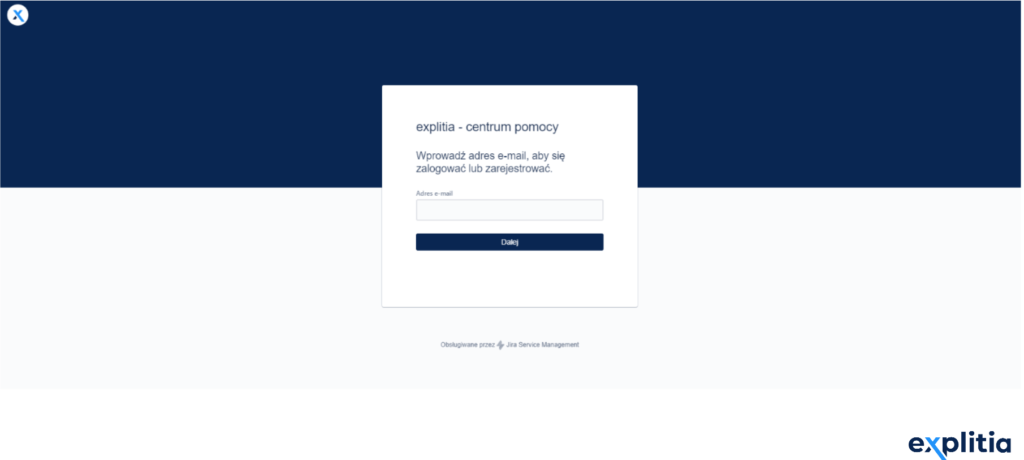
At explitia, we use Jira to manage the entire process. All stakeholders have access to the tool: clients, service specialists, supervisors, and project managers. Clients can submit requests via email or through a dedicated interface, and then track the status, priority, progress, and comments in real time. The system automatically notifies them of any changes.
In practice, Jira becomes a complete information hub for all service-related activities, giving clients full visibility and confidence in how their requests are being handled.
Benefits of explitia’s SLA – More than just a contract
Although a Service Level Agreement (SLA) is a formal document, its value goes far beyond the contract itself. At explitia, it represents full support for the day-to-day use of IT systems.
- Confidence in Crisis Situations – Without service support, an employee on a night shift would have to act intuitively: searching for internal IT contacts or sending an email that might only be read in the morning. An SLA ensures that once a request is submitted, the support mechanism is activated. It guarantees that even at night or on holidays, someone responsible and knowledgeable takes action to minimize losses.
- Cost and Time Optimization – Without continuous technology support, costs can quickly spiral, as every situation is treated ad hoc. Resolving issues takes time: finding the right people or company to assist, negotiating, and preparing additional documentation—all of which can generate significant losses. Continuous service ensures immediate response, predictable costs, and effective prioritization of requests, making resource use rational and efficient.
- Maintaining Stability and Performance – Good support is not just reactive; it is also proactive. It includes regular system monitoring, planning updates, performance audits, and preventive maintenance to catch potential issues before they become failures. This is a continuous optimization process, not just “firefighting.”
explitia SLA – Partnership and Professionalism
Automation and the use of IT systems in production processes are now standard, enabling process optimization, lean manufacturing, waste reduction, and safer, more efficient production.
However, the true success of an IT system implementation is only verified after deployment, when the solution can operate reliably and effectively. That’s why proper technology support is essential—it ensures that the investment continues to deliver value over the years and that employees actively use the IT tool.
It’s worth noting that explitia’s service support covers not only our own MES systems but also custom solutions, systems based on third-party software, and even ERP components. We serve clients across sectors—from automotive, chemical, and household appliances to food production—in Poland and abroad (not only in Europe).
At explitia, flexibility, client-focused adaptation, and full professionalism are the hallmarks of every project. When we commit to being available at 2 a.m., we are fully ready to provide support. As Head of the Service Department, I can confidently say that the explitia service team does outstanding work.
An SLA is not just a document with measurable indicators—it is a commitment to care and partnership. This level of support gives our clients peace of mind, allowing them to rely on help whenever it is needed.
Don’t risk downtime – provide your production with expert IT support